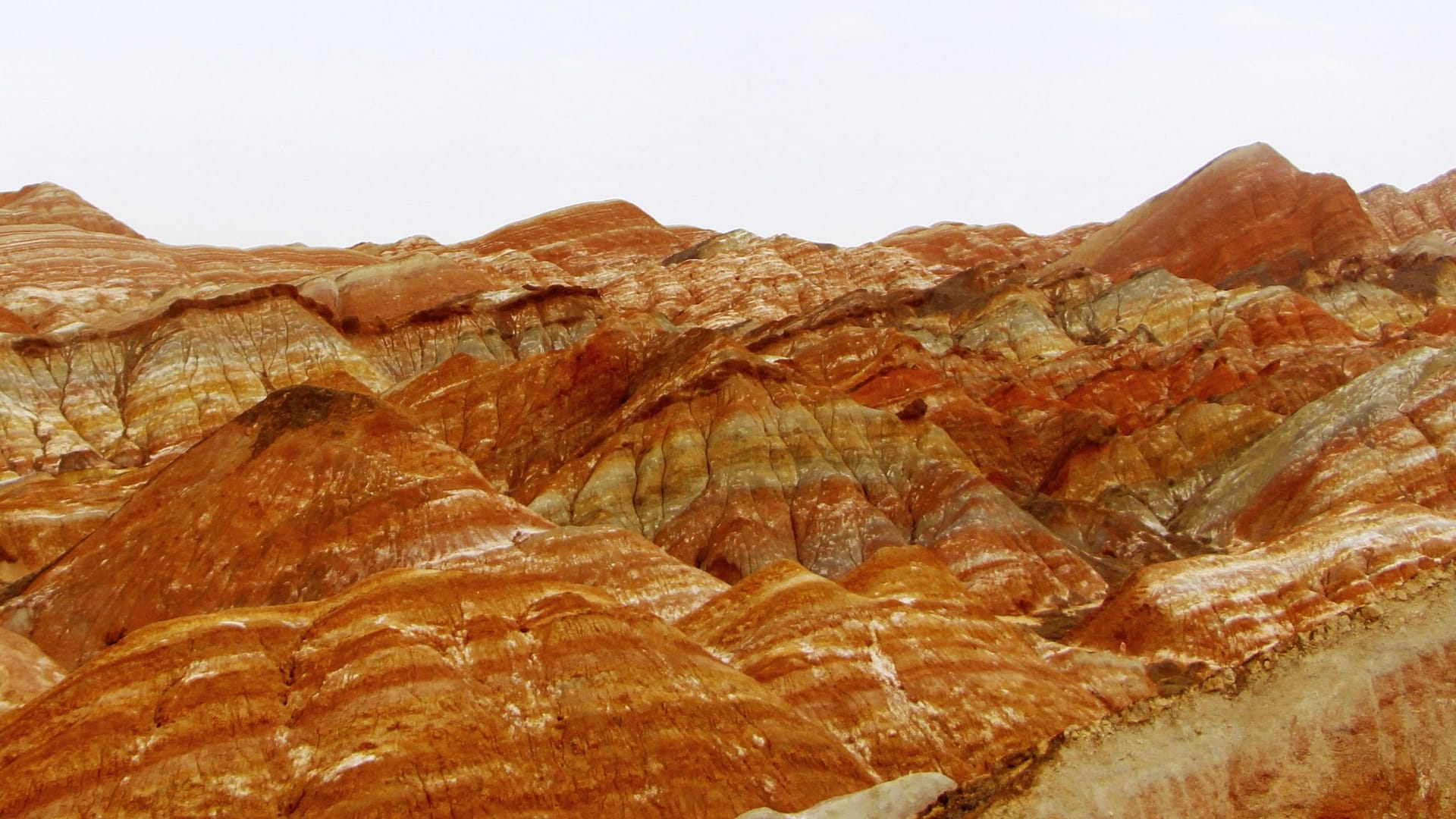
A brief history of Gansu
Gansu is a long, narrow province in China’s northwest — a 1,600 km stretch of mountains, deserts and oases that for two thousand years has been the country’s gateway to Central Asia. According to the Wikipedia history of Gansu, the province sits along the Hexi Corridor — the narrow band of grassland and oasis cities wedged between the Qilian Mountains and the Gobi Desert that the Silk Road threaded through for more than a millennium.
Gansu first entered Chinese history under the Han dynasty. In 121 BCE the general Huo Qubing drove the Xiongnu confederation out of the Hexi Corridor, and Emperor Wu established the “Four Commanderies of Hexi” — Wuwei, Zhangye, Jiuquan and Dunhuang — to garrison the new route west. Within a century, Buddhist monks were following Chinese caravans east; from the 4th century on, dynasty after dynasty carved cave-temples into Gansu’s cliffs, leaving the world’s longest continuous record of Buddhist art outside India.
Gansu is the corridor — the long thin door between China and the world. Walk it east to west and you cross deserts, two great wall ends, three UNESCO grottoes, and almost two millennia of Buddhist murals.
The Tang dynasty (618–907) turned Gansu into the imperial highway — what UNESCO now recognises as the Silk Roads: Chang’an–Tianshan Corridor World Heritage Site. Dunhuang grew into a cosmopolitan trading city where Sogdian merchants, Indian monks and Tibetan envoys passed through Chang’an’s western gate. After the Tang fell, the Tangut people built the Western Xia kingdom (1038–1227), ruling Gansu and Ningxia until Genghis Khan’s Mongols destroyed it. The Ming dynasty rebuilt the corridor’s defences, anchoring the Great Wall’s western terminus at Jiayuguan Fortress in 1372 — the door through which Ming China faced the outside world for three hundred years.
The modern chapter began with industrialisation under the People’s Republic — Lanzhou became China’s first nuclear-fuel city and a major petrochemical centre, and the province pioneered wind and solar farms across its high desert plateaus. Today Gansu is one of China’s top wind-power provinces, a fast-growing Silk Road tourism destination, and the host of newly restored cultural sites along the entire Hexi Corridor. For wider context on where Gansu sits in Chinese geography, see our guide to China’s provinces.
Gansu dialects and Standard Mandarin
Gansu sits at the meeting point of two Mandarin sub-families. Most of the province — including the capital Lanzhou and the entire Hexi Corridor — speaks Lanyin Mandarin , named for Lanzhou and Yinchuan. The eastern districts around Tianshui and Pingliang shade into Central Plains Mandarin, the same family that includes the Mandarin of Xi’an and the Wei river valley.
Both groups are mutually intelligible with Standard Mandarin — a learner who knows Putonghua will follow a Lanzhou taxi driver or a Dunhuang shopkeeper without difficulty. The accent has a slightly nasal, rolling rhythm, with the famous Lanzhou “broad r” colouring word endings and a slower, more deliberate pace than Beijing Mandarin. Eastern Gansu speech rolls more smoothly into Shaanxi tones; western Gansu speech, especially in Dunhuang, sounds drier and crisper — shaped by centuries of Silk Road traders meeting halfway.
Beyond Mandarin, Gansu is home to several ethnic minority languages . Tibetan is widely spoken in the Gannan Tibetan Autonomous Prefecture in the southwest (centred on Xiahe and the Labrang Monastery); the Hui Muslim population speaks Mandarin with Arabic and Persian loanwords for religious vocabulary; the Mongolian-speaking Sunan Yugur Autonomous County preserves the Yugur language (a rare Turkic-Mongolic hybrid); and the Dongxiang and Bonan minorities speak Mongolic languages found nowhere else.
For everyday travel and study, Standard Mandarin is universal across Gansu — education, signage and media are all Putonghua-medium. A Mandarin learner who’s been studying for six months can travel the whole 1,600 km Hexi Corridor confidently. For the wider picture, see our guide to languages and dialects in China.
Quirky Gansu phrases worth knowing
Six classic Gansu phrases with pinyin readings. Tap 🔊 to hear the audio — Lanyin Mandarin is a regional Mandarin family, so the audio plays the Standard Mandarin reading of the characters; a Lanzhou speaker would say the same words with the local nasal, rolling delivery.
The northwest-Mandarin shortening of 啥 (shá) and 什么 (shénme). Nǐ chī sǎ? means “what are you eating?” — one of the first words you’ll hear in a Lanzhou noodle shop.
The Lanzhou favourite. A meal can be zǎnjìn, a friend’s outfit can be zǎnjìn, a piece of work can be zǎnjìn. Pronounced with the slow Gansu drawl, it’s the all-purpose Northwest compliment.
A classic Northwest Mandarin verb — to sit, drink tea and gossip. Lanzhou tea-houses turn piǎn into an afternoon. The standard-Mandarin equivalent is 聊天 (liáo tiān).
An emphatic adjective shared across Gansu, Shaanxi and Shanxi. Liáo de hěn means “really great”; liáo zhā lie is the full Northwest emphatic version — “absolutely fantastic”.
Distinctly Northwestern. Méi má dá means “no problem”. Heard everywhere from Lanzhou taxi drivers to Dunhuang oasis guides — once you’ve picked it up, you’ll spot Northwest Mandarin speakers anywhere in China.
Northwest Mandarin shorthand for 地方 (dìfang). Zhè gā da means “this place”. A local Tianshui or Lanzhou speaker will scatter gāda through directions and small-talk.
Gansu cuisine: hand-pulled noodles, lamb and the Silk Road table
Gansu cooks on the meeting line between Han Chinese, Hui Muslim and Tibetan kitchens — a wheat-and-lamb cuisine that emerged from the Hexi Corridor’s caravans and never really stopped evolving. The signature is hand-pulled noodles in clear beef broth, and the soundtrack is the slap of dough on a cutting board at five in the morning. For a wider lens see our regional Chinese cuisine guide.
Lanzhou beef noodles
兰州牛肉面 · Lánzhōu niúròu miànGansu’s signature dish, and arguably China’s most-eaten breakfast — hand-pulled wheat noodles in a deeply spiced clear beef broth, finished with white radish, chopped coriander, garlic chives, and a spoonful of fragrant chilli oil. The classic order asks for one of nine noodle thicknesses, from gossamer 毛细 (máoxì) to flat 大宽 (dàkuān). The dish was codified in Lanzhou in 1915 and is now sold in tens of thousands of shops worldwide.
Hand-grabbed mutton
手抓羊肉 · Shǒu zhuā yáng ròuThe Hexi Corridor’s lamb dish — large bone-in pieces of mountain mutton simmered slowly with nothing more than salt, ginger and Sichuan pepper, then served on the plate ready to be picked up and eaten with the fingers. A signature of the Hui Muslim kitchens in Linxia and the Tibetan kitchens of Gannan. Pair with raw garlic and a bowl of broth.
Niang pi cold noodles
酿皮 · Niàng píCold, wide ribbons of steamed wheat-gluten noodle, dressed with vinegar, garlic, sesame paste and a generous spoon of red chilli oil. A Lanzhou summer staple — slippery, sour, fiery and the perfect counterpoint to the heavy meat dishes. Best eaten standing up at a market stall on a hot day.
Dunhuang donkey-meat yellow noodles
敦煌驴肉黄面 · Dūnhuáng lǘròu huángmiànThe signature Dunhuang dish — fresh yellow alkaline noodles pulled into chopstick-thick ropes, topped with cold sliced donkey meat braised in Silk Road spices. Said to have been served to Tang-dynasty pilgrims on their way to Mogao. Donkey meat is still considered the highest-grade lean meat in the Hexi Corridor; the noodles’ yellow colour comes from the alkaline water used in dough.
Notable cities of Gansu
Gansu unfurls from the Yellow River in the southeast to the Gobi in the far west — five distinct cities frame the province’s character, from the Hui-Muslim capital and the Great Wall’s western terminus to the oasis end of the Silk Road:

Lanzhou兰州
Lanzhou is the only provincial capital that the Yellow River runs straight through — a long, narrow city of high-rises wedged between two mountain ridges along the river’s banks. The iron Zhongshan Bridge (built 1909, the river’s “first bridge”) is the city’s signature monument, lit gold every evening above the slow brown water.
Lanzhou is China’s hand-pulled beef-noodle capital — the dish was codified here in 1915, and every Lanzhou native has a strong opinion about which neighbourhood shop pours the best broth. Beyond the noodles, the city is a launchpad for the Hexi Corridor: high-speed trains run west to Dunhuang, Jiayuguan and Zhangye, and Bingling Temple Grottoes are an hour’s boat ride upstream.
Deep-dive guide coming soon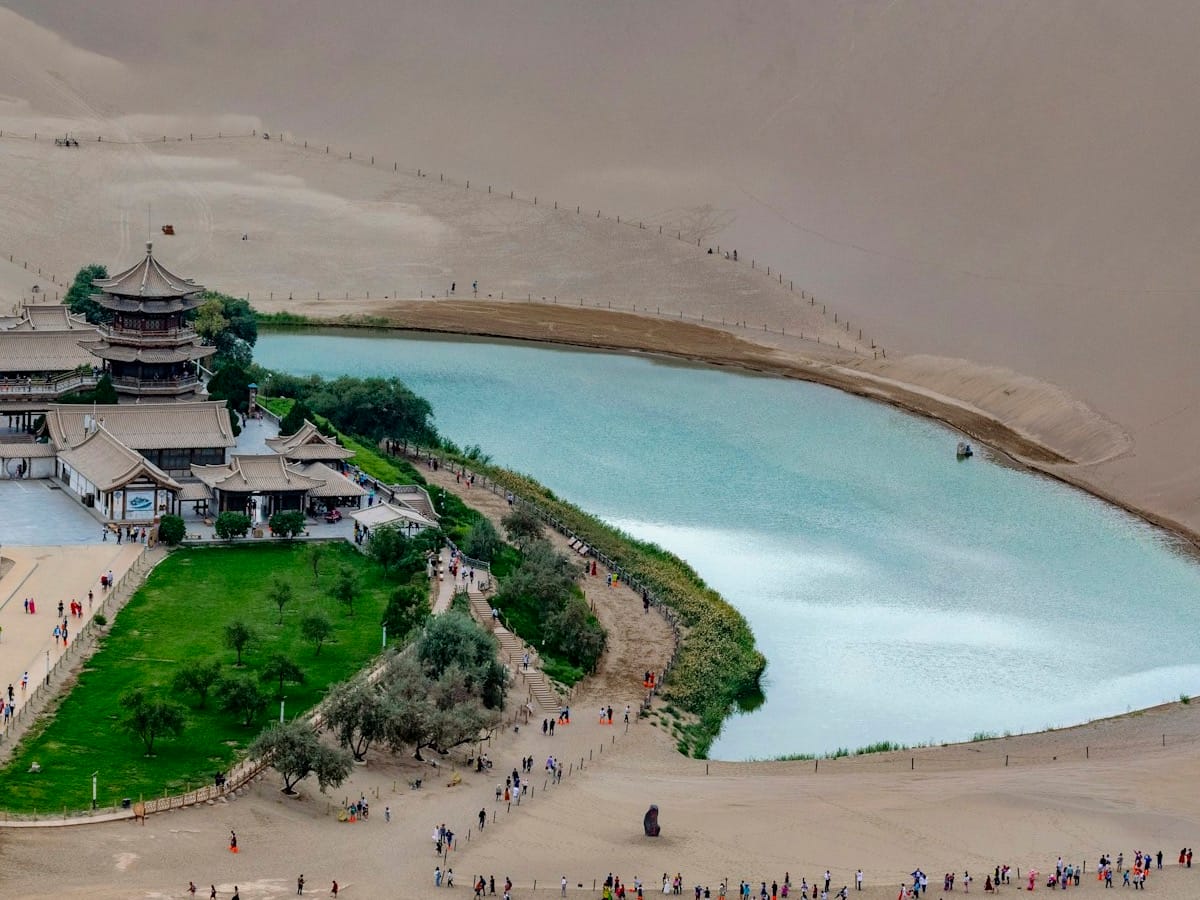
Dunhuang敦煌
A 2,100-year-old oasis at the corridor’s western end — home to the UNESCO Mogao Caves and the desert-cradled Crescent Lake oasis.
Deep-dive guide coming soon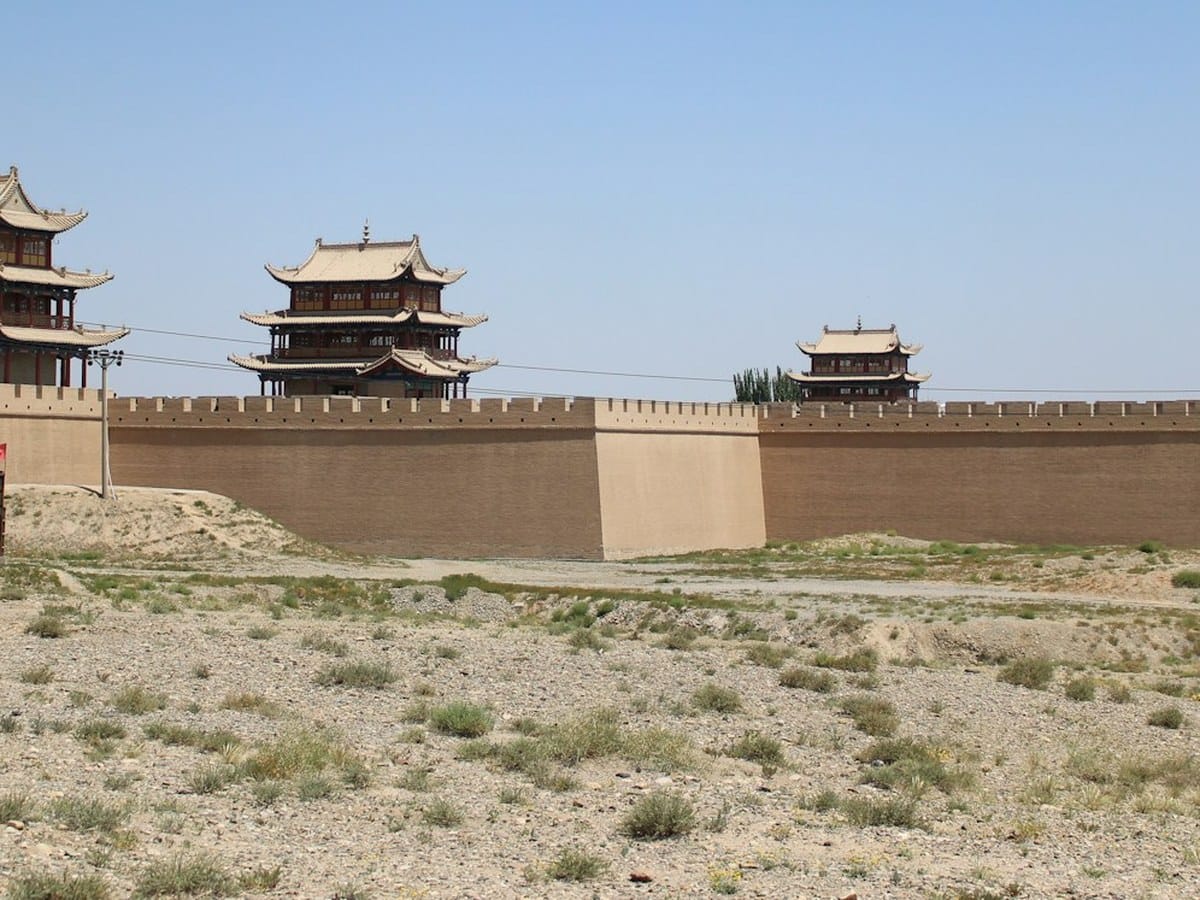
Jiayuguan嘉峪关
A Ming-dynasty garrison town at the corridor’s narrowest pass — home to Jiayuguan Fortress and the Ming Great Wall‘s western gate.
Deep-dive guide coming soon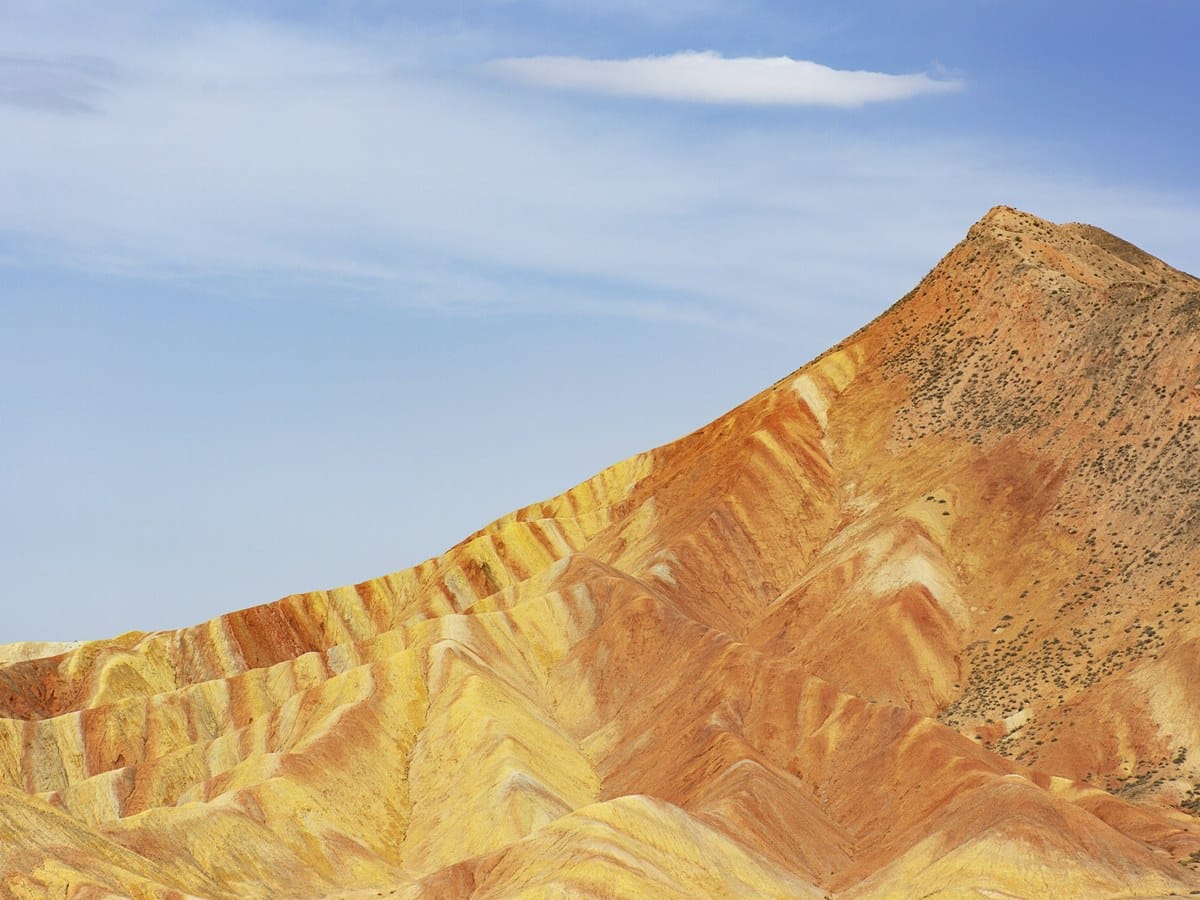
Zhangye张掖
A Silk Road oasis at the corridor’s midpoint — home to the UNESCO Zhangye Danxia mountains and Dafo Temple‘s reclining Buddha.
Deep-dive guide coming soon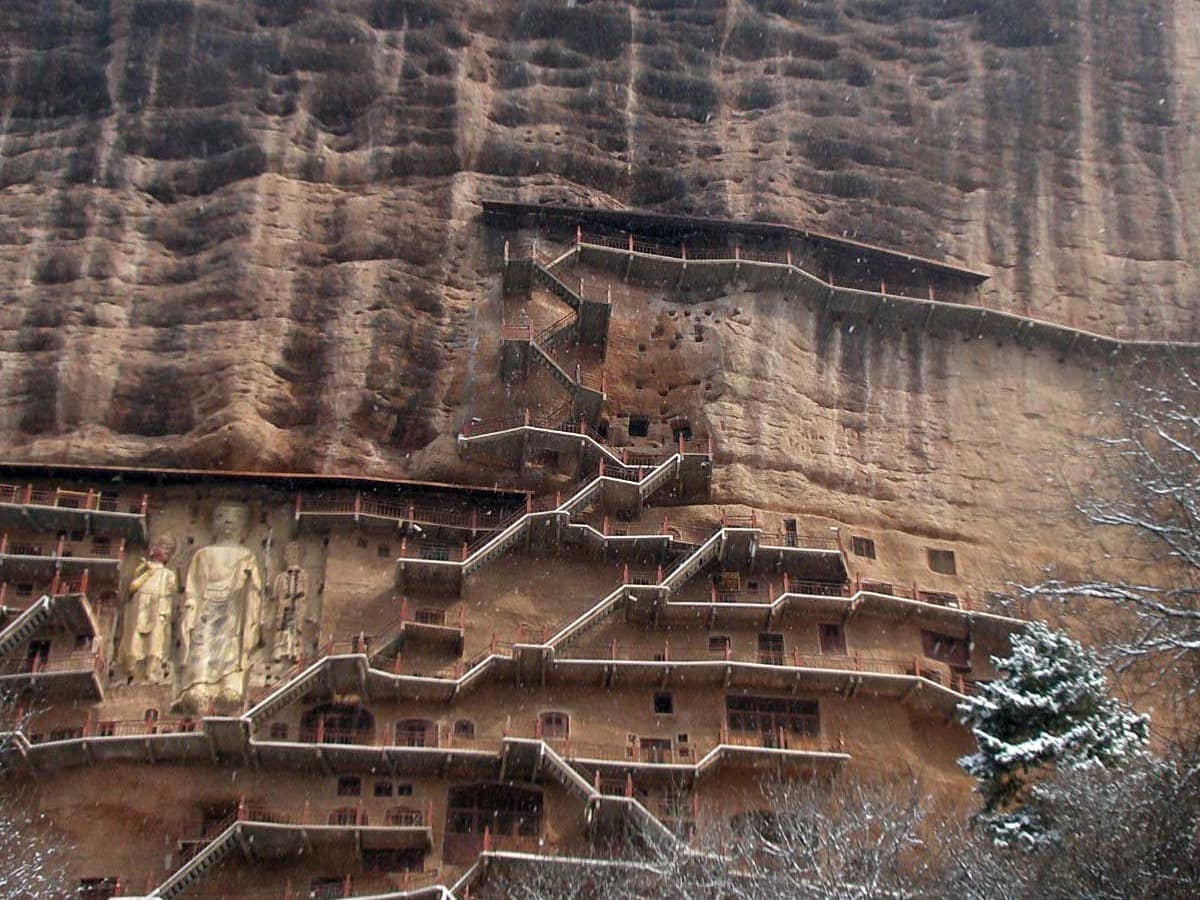
Tianshui天水
Eastern Gansu’s ancient cradle of civilisation — home to the UNESCO Maijishan Grottoes and the Fuxi Temple honouring China’s first ruler.
Deep-dive guide coming soonIconic attractions across the province
Gansu holds three UNESCO World Heritage sites along the Silk Road plus the western terminus of the Great Wall — five landmarks worth planning your trip around:
Mogao Caves 莫高窟
UNESCO World Heritage. 492 Buddhist cave-temples carved into a desert cliff outside Dunhuang between the 4th and 14th centuries — a thousand years of murals and sculpture, including the famous Sealed Library Cave discovered in 1900 with 50,000 manuscripts in twenty languages. Access is now strictly timed-ticket; book months ahead in peak season.
Zhangye Danxia 张掖丹霞
UNESCO World Heritage (part of China Danxia). A 50-square-kilometre stretch of layered red, orange, yellow and green sandstone — the country’s most photogenic geology, formed by 24 million years of mineral-rich sediment laid down by ancient lakes. Best at sunrise or the first hour after sunrise; tour-bus loops connect four viewing platforms.
Jiayuguan Fortress 嘉峪关
The Ming Great Wall’s western terminus, built in 1372 and known as the “First and Greatest Pass Under Heaven”. Three nested fortresses guard the narrow gap between the Qilian Mountains and the Gobi — three watchtowers, two great gates and a famous tale of the master builder who calculated the brick count so precisely that just one spare brick remained.
Crescent Lake & Mingsha Sand Dunes 月牙泉 · 鸣沙山
A crescent-shaped freshwater spring that has somehow survived in the middle of the singing sand dunes outside Dunhuang for at least two thousand years, framed by a Tang-style pagoda complex. Climb the dunes at sunset; the sand resonates as it slides.
Labrang Monastery 拉卜楞寺
One of the six great monasteries of the Gelug school of Tibetan Buddhism — a sprawling temple complex in Xiahe in southwestern Gansu, home to up to 4,000 monks at its 18th-century peak. The morning prayer-wheel circumambulation is one of the most atmospheric living-religious experiences in China.
Famous Gansuese figures
Six figures from or shaped by Gansu — across mythology, dynasty-defining generalship and the modern industrial age.
Fuxi (伏羲)
The mythological first sovereign of the Chinese people, traditionally credited with inventing fishing, writing and the Eight Trigrams of the I Ching. Chinese tradition places his birthplace in Tianshui (eastern Gansu), where an ancient Fuxi Temple still hosts ritual ancestral worship every June.
Li Guang (李广)
The “Flying General” of the Han dynasty, born in Longxi (modern Tianshui). Famed for fighting the Xiongnu on the northern frontier across more than forty campaigns — a Han hero immortalised in the Tang-dynasty poetry of Wang Changling and a folk archetype of frontier valour.
Jiang Wei (姜维)
Tianshui-born military strategist who served Zhuge Liang and, after Zhuge’s death, became the chief defender of the Shu Han kingdom against the rising state of Wei. One of the most romantically tragic figures of the Three Kingdoms era — and a major character in Luo Guanzhong’s classic novel.
Duan Xiushi (段秀实)
Born in Pingliang (eastern Gansu). A celebrated Tang loyalist who refused to bow to the rebel Zhu Ci during the Jingyuan Mutiny of 783 and was killed for it. Held up for over a millennium in Chinese tradition as the model of a courageous official under impossible pressure.
Wang Jinxi (王进喜)
Born to a poor farming family in Yumen, western Gansu. Led the team that broke open the Daqing oil field in 1960, working through a Manchurian winter without proper equipment — the “Iron Man” became the symbol of post-revolution Chinese industrial self-reliance and is still on the school curriculum today.
Huang Xuan (黄轩)
Lanzhou-born actor, trained at the Beijing Dance Academy. Lead roles in The Wasted Times, Mr Six and the international hit drama Nothing but Thirty have made him one of contemporary China’s most recognisable leading men, and a regular ambassador for Lanzhou’s cultural and tourism campaigns.
Gansu’s modern economy & global role
Gansu’s modern economy is built on three pillars — Silk Road heritage tourism, heavy industry around Lanzhou, and one of the world’s largest concentrations of wind and solar power. The province’s geography that historically made it a corridor between worlds now makes it China’s most strategic clean-energy and rare-earths region.
One of China’s top wind & solar provinces
The Hexi Corridor’s high desert and steady wind have turned Gansu into a renewable-energy powerhouse — the Jiuquan Wind Power Base is one of the world’s largest, and solar farms now stretch for hundreds of kilometres along the corridor. Roughly half of Gansu’s installed generation capacity is now wind, solar or hydro.
Petrochemicals and rare earths
Lanzhou hosts one of China’s oldest petrochemical complexes and the country’s pioneer nuclear-fuel facility. Gansu sits on major lithium, nickel and rare-earth reserves — Jinchang, north of Wuwei, is China’s most important nickel-mining city and the source of much of the country’s strategic-metals supply.
Dry-land grain and apples
Despite a famously arid climate, Gansu is a major wheat, maize and apple producer — the Tianshui apple is one of China’s top-rated table apples, and the high-altitude potato of central Gansu has been promoted as a national staple-food crop. Dryland farming techniques developed here are now exported across China’s drier provinces.
The Silk Road tourism corridor
Gansu now welcomes over 350 million domestic visitor-trips per year — driven by Dunhuang, Zhangye Danxia and Jiayuguan, all directly connected by the Lanzhou–Xinjiang high-speed rail. The Belt and Road revival has put Silk Road tourism back at the centre of provincial strategy.
Why Gansu matters for Mandarin learners
The most rewarding region in China to use your Mandarin
Gansu is one of the most rewarding regions of China to spend time in for a Mandarin learner — Standard Mandarin is universal, the regional accent is gentle and rolling rather than tonally complex, and the Silk Road history along the Hexi Corridor gives almost every conversation a story to anchor on. Bus drivers, hotel staff, noodle-shop owners and museum guides will all happily slow down for a learner; tour groups are mostly Chinese, so practising Mandarin is the natural choice.
The bonus, unique to Gansu, is the religious-cultural spectrum you can hear in a single week — Hui Muslim Arabic-flavoured greetings in Linxia, Tibetan chanting at Labrang, the Buddhist murals of Mogao narrated by Mandarin-speaking guides, and the dry desert dialect of Dunhuang’s market traders. For the bigger picture of getting started, see our guide to learning Mandarin as an adult, and for the full landscape of Chinese languages our guide to languages and dialects in China.
Visiting Gansu — practical notes
Best time
May–June and September–October — warm, dry, the cleanest light for Mogao and Zhangye Danxia. Avoid July–August (peak crowds, high heat) and December–February (deep cold across the corridor, with snow at the high prefectures).
Getting around
The Lanzhou–Xinjiang high-speed rail links Lanzhou to Zhangye, Jiayuguan and Dunhuang along the full Hexi Corridor in under nine hours. Within cities, taxis and Didi are cheap; rental cars work well between Zhangye and Dunhuang.
Climate
Bone-dry across most of the province — pack lip balm and an SPF50 sunscreen. Daily temperature swings are sharp (often 15–20 °C between dawn and afternoon), so layers matter. Sandstorms can blow through the corridor in early spring.
Visa
240-hour transit visa-free entry for many nationalities (as of 2026); Lanzhou is a transit-eligible city. Most travellers fly into Lanzhou or Dunhuang directly, then move overland east-west via the high-speed rail.
Language
Standard Mandarin is universal — Gansu is one of the most learner-friendly provinces to practise in. English is patchy outside the Dunhuang tourist core. A few key phrases in Mandarin go a long way.
Costs
One of mainland China’s cheaper provinces for travellers — Lanzhou beef noodles from ¥10, basic guesthouses from ¥150, even Dunhuang’s premier desert-camp hotels remain affordable compared to coastal cities.
Useful Mandarin phrases — tap to hear
- 你好 (nǐhǎo)Hello
- 谢谢 (xièxie)Thank you
- 多少钱? (duōshao qián?)How much?
- 我要这个 (wǒ yào zhège)I want this
For a fuller traveller’s phrase set, see our essential Mandarin phrases for travelling to China.
Test your Gansu knowledge
1. The Gansu dialect of Mandarin is part of which Chinese language family?
2. Which of these landmarks marks the western end of the Ming Great Wall?
3. Gansu’s signature dish is:
Frequently asked questions
Start your Mandarin journey
Want to learn the Standard Mandarin spoken across Gansu and the rest of China? Online 1-on-1 lessons with a native speaker.