
A brief history of Sichuan
Sichuan is a fertile basin ringed by mountains on every side — geography that has made it both extraordinarily rich and extraordinarily hard to invade. According to the Wikipedia history of Sichuan, the region was home to the ancient Shu and Ba kingdoms, whose bronze-age Sanxingdui civilisation (1200 BCE) produced the most distinctive bronzes of the Chinese Bronze Age — towering, almond-eyed masks unlike anything in the central plains.
The Qin dynasty absorbed Shu in 316 BCE, and in 256 BCE the Qin governor Li Bing built the Dujiangyan irrigation system — a dam-free water-diversion masterpiece that still feeds the Chengdu plain 2,280 years later. That single engineering decision turned Sichuan into China’s grain basket and earned it the nickname Tiānfǔ zhī Guó (天府之國, “Heaven’s Storehouse”).
Sichuan has been China’s refuge, its larder, and its laboratory of flavour — defended by mountains, fed by Dujiangyan, and seasoned by Sichuan peppercorn.
In the Three Kingdoms era (220–280 CE), Sichuan was the seat of the Shu Han kingdom — the romanticised state of warlord Liu Bei and his strategist Zhuge Liang, both of whom appear in Chengdu’s Wuhou Shrine today. The Tang dynasty made Chengdu a refuge city for emperors fleeing rebellions, and the Tang poets Li Bai (raised in Mianyang) and Du Fu (who settled in Chengdu) both produced their best-known work here.
The modern chapter began in 1949 with industrialisation, then accelerated dramatically after the 2008 Wenchuan earthquake, which devastated northern Sichuan but triggered massive infrastructure investment. Today Chengdu rivals Shanghai as China’s most expat-friendly mainland city. For wider context on where Sichuan sits in Chinese geography, see our guide to China’s provinces.
Sichuanese and Standard Mandarin
Unlike Cantonese or Shanghainese — separate Chinese languages with their own grammar and not mutually intelligible with Mandarin — Sichuanese is part of the Southwestern Mandarin family. A speaker of Standard Mandarin and a speaker of Sichuanese can hold a conversation, sometimes with friction over vocabulary and a few pronunciation surprises, but mostly fine.
What gives Sichuanese its instantly recognisable flavour is its rhythm. The tones land softer than in northern Mandarin — Sichuan locals often glide where Beijingers clip — and the speech is full of sentence-final particles like 嘛 (ma), 噻 (sai) and 嘞 (lei) that give every utterance a warm conversational feel. There is also a famously rich slang lexicon: phrases like 巴适 (bā shi, “perfect”), 安逸 (ān yì, “comfortable”) and 摆龙门阵 (bǎi lóng mén zhèn, “shooting the breeze”) are everyday Sichuan and rarely heard outside the province.
The practical good news for learners: Standard Mandarin is universal in Sichuan. All education is Mandarin-medium, all signage is Mandarin, and most working-age locals switch between Mandarin and Sichuanese fluidly. Spending time in Chengdu is one of the best ways to train your ear in regional Mandarin variation without losing comprehension. Sichuan’s western prefectures — Garze and Aba — are Tibetan and Qiang autonomous regions where you’ll also hear those languages alongside Mandarin.
For the wider picture of how Sichuanese fits among Chinese languages, see our guide to languages and dialects in China.
Quirky Sichuanese phrases worth knowing
Six classic Sichuanese phrases with pinyin readings. Tap 🔊 to hear the audio — Sichuanese is Southwestern Mandarin, so the audio plays the Standard Mandarin reading of the characters; a Sichuanese speaker would say the same words with a slightly softer, more melodic delivery.
The signature Sichuan word — used for everything from a great meal to a perfect afternoon to a comfy pair of shoes. The local life-philosophy in two syllables.
The close cousin of 巴适. Captures the Sichuan attitude that life should be unhurried — a teahouse afternoon, a slow noodle lunch, time to chat.
Literally “setting up the dragon-gate formation” — what Sichuan locals do at teahouses for hours: gossip, debate, joke, stretch a single cup of tea across an entire afternoon.
The Sichuan version of “all good” — instantly identifies a Sichuanese speaker. Used to agree, accept a suggestion, confirm a plan.
Sichuan’s version of 什么 (shénme). Said with a rising tone at the end of any sentence, it’s the local equivalent of “huh?” or “what’s that?”.
Literally “it doesn’t exist” — but in Sichuanese, the all-purpose dismissive shrug meaning “don’t worry about it” or “it’s nothing”. Said after a thank-you, an apology, or any small fuss.
Sichuan cuisine: mala, hot pot and the numbing peppercorn
Sichuan cuisine is the most globally exported regional Chinese cooking — Sichuan hot pot has restaurants on every continent, and mapo tofu is on more Chinese restaurant menus worldwide than any other dish. The defining technique is málà 麻辣 — the combination of tongue-numbing Sichuan peppercorn (花椒, huā jiāo) with dried red chillies, a sensation that doesn’t exist in any other major world cuisine. For a wider lens see our regional Chinese cuisine guide.
Mapo tofu
麻婆豆腐 · Mápó dòufuSoft silken tofu braised in a fiery sauce of fermented broad-bean chilli paste (doubanjiang), minced beef and Sichuan peppercorn. Named after the “pock-marked grandmother” who invented it in 19th-century Chengdu. The most globally recognised Sichuan dish.
Sichuan hot pot
火锅 · HuǒguōThe local communal ritual — a bubbling cauldron of red oil, beef tallow, chillies and Sichuan peppercorn at the centre of the table, into which everything is dipped. Often served as yuanyang (mandarin-duck) pot with a mild side for guests who can’t take the heat.
Kung pao chicken
宫保鸡丁 · Gōngbǎo jīdīngDiced chicken stir-fried with dried chillies, Sichuan peppercorn, peanuts and a tangy sweet-sour-spicy sauce. Named after a Qing-dynasty governor’s title. The international restaurant-menu version is usually milder than the real Sichuan one.
Dan dan noodles
担担面 · Dàn dàn miànThe Chengdu street-food classic — thin wheat noodles topped with crispy minced pork, preserved vegetables, peanuts and a generous slick of chilli oil and Sichuan peppercorn. Eaten quickly, ideally standing up at a tiny stool.
Notable cities of Sichuan
Sichuan is geographically enormous — the basin alone is bigger than Italy, and the mountainous western prefectures stretch right up to the Tibetan plateau. Five distinct cities frame the province’s character, from the hipster megacity capital to the Tibetan-edge sacred peaks:

Chengdu成都
Chengdu is the laid-back, teahouse-loving, panda-adjacent megacity that has somehow become both China’s gaming capital and its most expat-friendly inland city. The Jin River cuts through the centre, where the lit-up Anshun Bridge sits beside the riverside bar streets, and locals stretch a single cup of jasmine tea across an entire afternoon.
Chengdu is the gateway to almost everything Sichuan is famous for — the Chengdu Research Base of Giant Panda Breeding sits on the city’s northern edge, Dujiangyan and Mt Qingcheng are 90 minutes away, and the Sichuan-Tibet highway begins here.
Deep-dive guide coming soon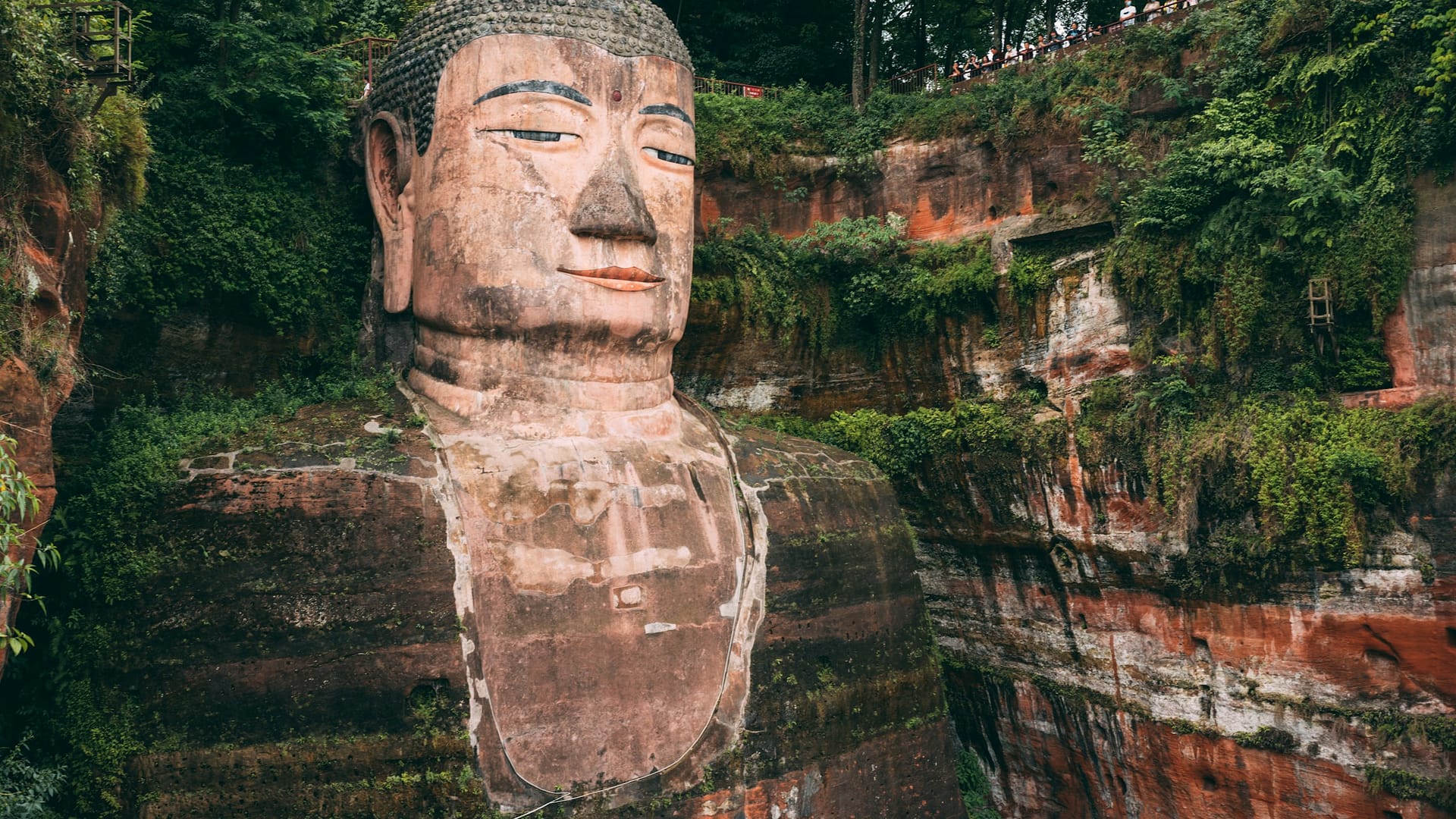
Leshan乐山
A small city by Chinese standards, defined by the staggering Leshan Giant Buddha — a 71-metre Tang-dynasty Maitreya carved into a riverside cliff at the confluence of three rivers. Carved over 90 years from 713 CE.
Deep-dive guide coming soon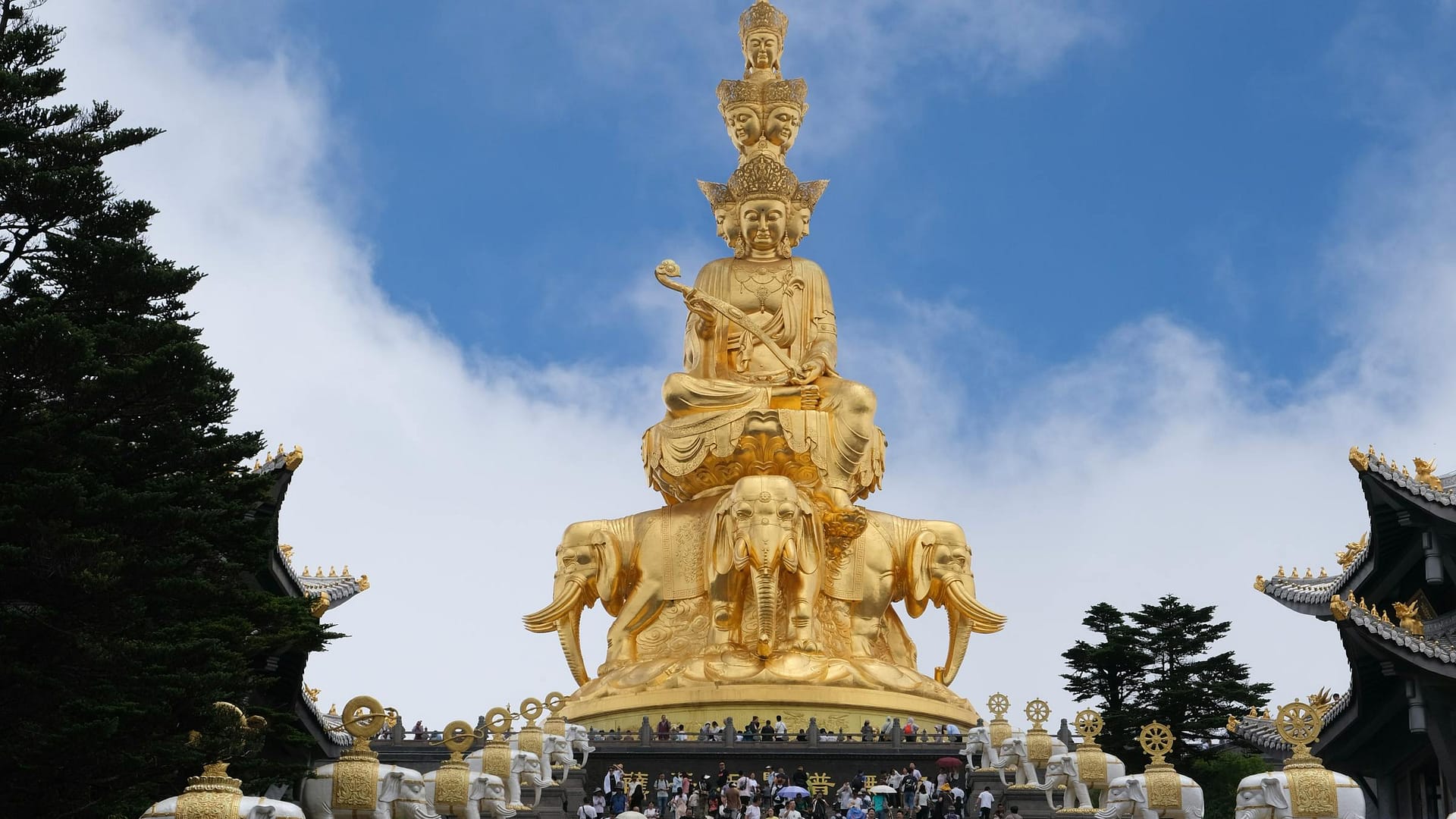
Mt Emei City峨眉山
The compact city at the foot of Mt Emei, one of China’s four sacred Buddhist mountains. The 3,099m Golden Summit hosts the 48-metre golden Samantabhadra statue and a famous Sea of Clouds at sunrise.
Deep-dive guide coming soon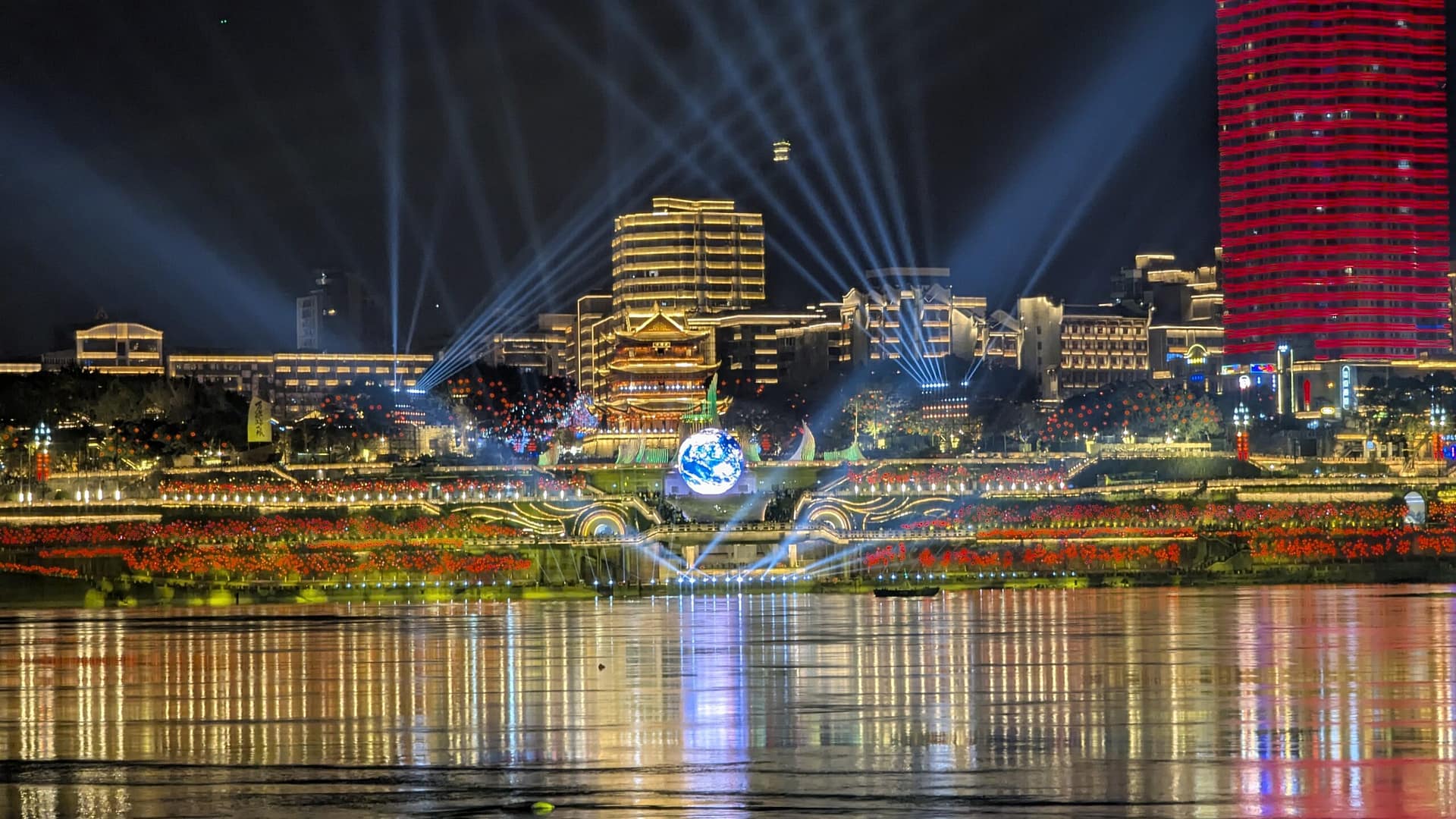
Yibin宜宾
At Yibin the Jinsha and Min rivers merge to form the Yangtze. The city is also home to Wuliangye, China’s most prestigious baijiu distillery — Sichuan produces roughly half of the country’s premium baijiu output.
Deep-dive guide coming soon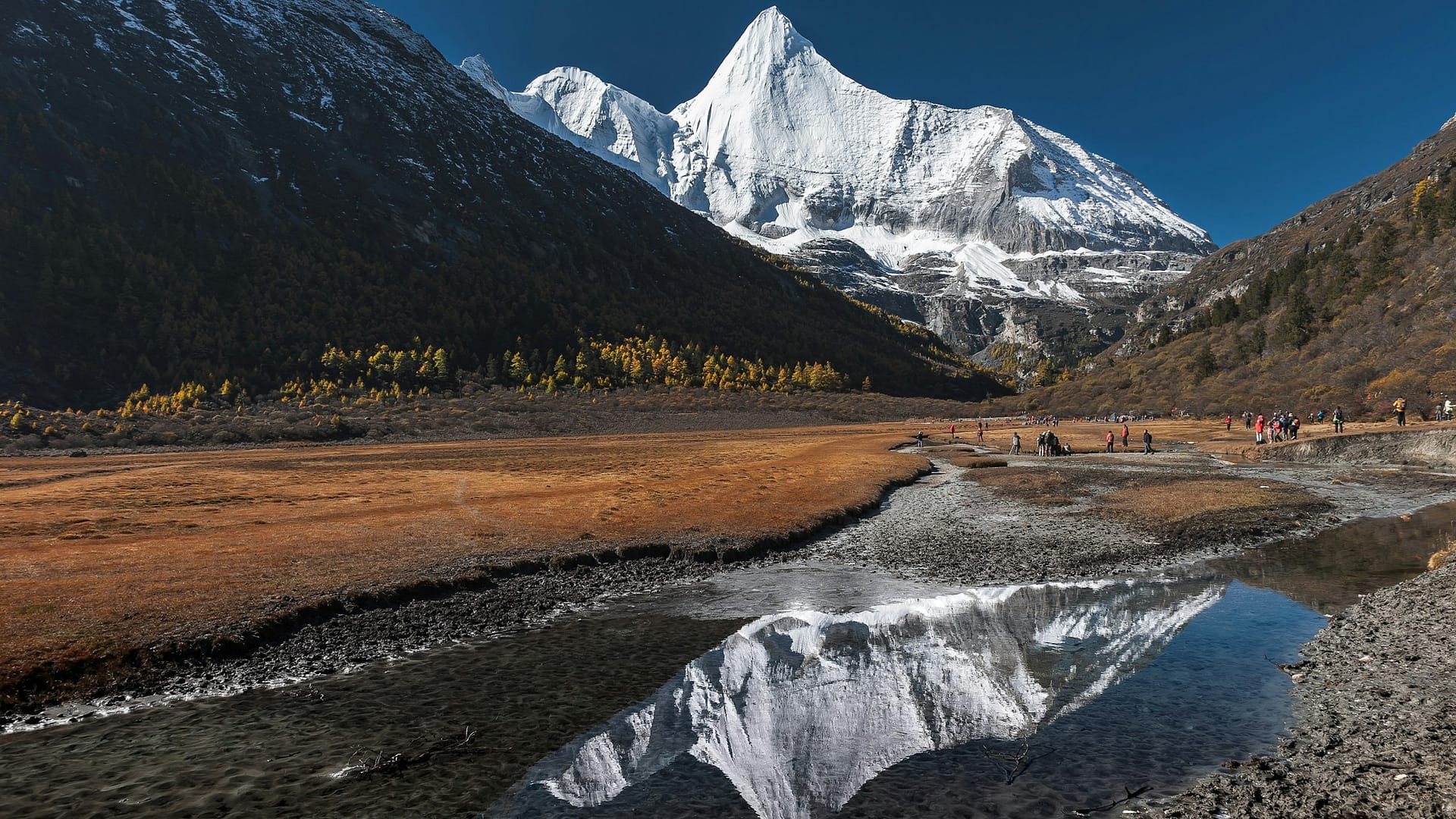
Daocheng稻城
A small Tibetan-edge county town at 3,750m elevation, deep in western Sichuan’s Garze prefecture. Daocheng is the gateway to Yading Nature Reserve and its Three Sacred Mountains — Chenrezig, Jambeyang and Chanadorje — three pyramidal snow peaks the Tibetans call the Last Shangri-La.
Deep-dive guide coming soonIconic attractions across the province
Sichuan packs four UNESCO World Heritage sites plus the world’s biggest panda conservation network into one province. Five landmarks worth planning your trip around:
Jiuzhaigou Valley 九寨沟
UNESCO World Heritage — a Tibetan-Qiang alpine valley in northern Sichuan known worldwide for its impossibly colourful turquoise, jade and emerald lakes, terraced waterfalls and Y-shaped travertine river system. Best visited in October when autumn foliage frames the lakes.
Mt Emei + Leshan Giant Buddha 峨眉山·乐山大佛
UNESCO World Heritage — a joint listing covering the sacred Buddhist mountain (3,099m Golden Summit, four temples, golden Samantabhadra statue, Sea of Clouds) and the 71-metre Tang-dynasty stone Buddha carved into a riverside cliff downstream.
Dujiangyan Irrigation System 都江堰
UNESCO World Heritage — a 2,280-year-old dam-free water-diversion engineering system, built by Qin governor Li Bing in 256 BCE and still in active use today. The ‘fish mouth’ Yu Zui divider, Anlan suspension bridge and Erwang Temple sit a 90-minute drive from Chengdu.
Sanxingdui Museum 三星堆
The new flagship museum displaying the bronze-age Sanxingdui civilisation — towering almond-eyed gold-leaf bronze masks, sacred trees and ritual objects unlike anything in central-plains China. Discovered 1929; explosively expanded with new finds in 2021.
Chengdu Panda Bases 大熊猫基地
The Chengdu Research Base of Giant Panda Breeding on the city’s edge plus the larger Dujiangyan and Wolong reserves — together home to over 200 captive-bred giant pandas. Morning is the only time pandas are reliably active.
Famous Sichuanese figures
Six figures born in Sichuan whose work shaped modern China — across a thousand years of poetry, painting, politics and literature.
Deng Xiaoping (邓小平)
Born in Paifang village, Guang’an, eastern Sichuan. The post-Mao leader whose 1978 “Reform and Opening Up” policy fundamentally rewrote modern China — and whose 1980 designation of Shenzhen as a Special Economic Zone reshaped the global economy.
Su Shi (苏轼)
Born in Meishan, central Sichuan — Song-dynasty poet, calligrapher, painter, statesman and reluctant exile whose work is considered the high-water mark of Song literature. The braised pork dish 东坡肉 (Dōngpō ròu) is named after him.
Li Bai (李白)
Raised in Jiangyou, Mianyang in northern Sichuan — Tang-dynasty Romantic poet famous for his wine-drinking, mountain-roaming and moon-gazing verses. One of the two most translated and recited poets in Chinese literature alongside Du Fu.
Zhang Daqian (张大千)
Born in Neijiang, Sichuan — one of the most influential and prolific Chinese painters of the 20th century. Famous for his sweeping splash-ink landscapes and as one of the most accomplished forgers of older masters in modern art history.
Ba Jin (巴金)
Born in Chengdu, real name Li Yaotang. His 1931 novel Family (家) — set in a Chengdu Confucian household — became one of the defining works of modern Chinese literature and a feminist landmark in Chinese culture.
Guo Moruo (郭沫若)
Born in Shawan, Leshan — Republican-era poet, historian and one of the founders of modern Chinese archaeology, who later served as the first president of the Chinese Academy of Sciences.
Sichuan’s modern economy & global role
Sichuan is the inland economic anchor of western China — a top-five Chinese provincial economy, the country’s largest baijiu producer and the home of a booming gaming and AI industry. After the 2008 Wenchuan earthquake, the province absorbed an extraordinary scale of infrastructure investment that has reshaped what it offers.
Chengdu gaming & AI hub
Tencent’s largest gaming studio (TiMi Studios — makers of Honor of Kings) sits in Chengdu’s High-Tech Zone, alongside Perfect World, NetEase and a growing AI cluster. Now widely called “China’s gaming capital”.
Mianyang “Science City”
Mianyang hosts the China Aerodynamics R&D Center, COMAC supplier cluster and the China Academy of Engineering Physics. Sichuan is a top supplier to the country’s commercial-aircraft programme and military aerospace.
The world’s spirit capital
Sichuan produces over half of China’s premium baijiu — Wuliangye (Yibin) and Luzhou Laojiao (Luzhou) are the two biggest names, with both distilleries operating uninterrupted since the Ming dynasty.
One of China’s top travel provinces
Sichuan attracts roughly 700 million domestic visitor-trips per year — driven by the giant panda bases, four UNESCO heritage sites, Chengdu’s food scene and the Tibetan-edge mountain landscapes of Garze and Aba.
Why Sichuan matters for Mandarin learners
The easiest mainland city to soft-land in after Shanghai
Chengdu has, over the past decade, quietly become one of the easiest mainland Chinese cities for an English-speaking newcomer to land in. The local pace is famously relaxed, the food is internationally familiar (mala chicken at home is the global gateway drug to Sichuan), and the city has a growing English-speaking professional community thanks to its tech and gaming industries.
For Mandarin learners, Sichuanese is the gentlest regional accent to start training your ear on — it’s Southwestern Mandarin, so you’ll still understand 90% of conversations on your first day. The remaining 10% is the rich local slang that makes Sichuan delightful. For the bigger picture of getting started, see our guide to learning Mandarin as an adult. For the wider picture of how Sichuanese fits among Chinese languages, see our guide to languages and dialects in China.
Visiting Sichuan — practical notes
Best time
April–June and September–November — mild weather, clearer skies. October for autumn foliage at Jiuzhaigou. Avoid hot humid summer and cold damp winter in the basin.
Getting around
Chengdu is the rail and air hub; high-speed rail to Leshan/Mt Emei in under 80 minutes. Western prefectures (Garze, Aba) need flights or long mountain drives.
Visa
240-hour transit visa-free entry for many nationalities (as of 2026). Chengdu is one of the transit cities.
Language
Standard Mandarin universal; Sichuanese (Southwestern Mandarin) widely heard. English better in central Chengdu than elsewhere.
Useful Mandarin phrases — tap to hear
- 你好 (nǐhǎo)Hello
- 谢谢 (xièxie)Thank you
- 多少钱? (duōshao qián?)How much?
- 我要这个 (wǒ yào zhège)I want this
For a fuller traveller’s phrase set, see our essential Mandarin phrases for travelling to China.
Test your Sichuan knowledge
1. Sichuanese is part of which Chinese language family?
2. The distinctive numbing sensation in Sichuan cuisine comes from:
3. Sichuan has how many UNESCO World Heritage sites?
Frequently asked questions
Start your Mandarin journey
Want to learn the Standard Mandarin spoken across Sichuan and the rest of China? Online 1-on-1 lessons with a native speaker.