付款
Paying

Paying in China as a foreigner

China went cashless faster than anywhere on Earth, and it did it in Mandarin. You can set up Alipay and WeChat Pay before you fly — the part nobody prepares you for is the thirty seconds at the counter when the code will not scan and the queue is waiting.
If you learn one sentence我扫你还是你扫我?Wǒ sǎo nǐ háishi nǐ sǎo wǒ?Do I scan you, or you scan me?
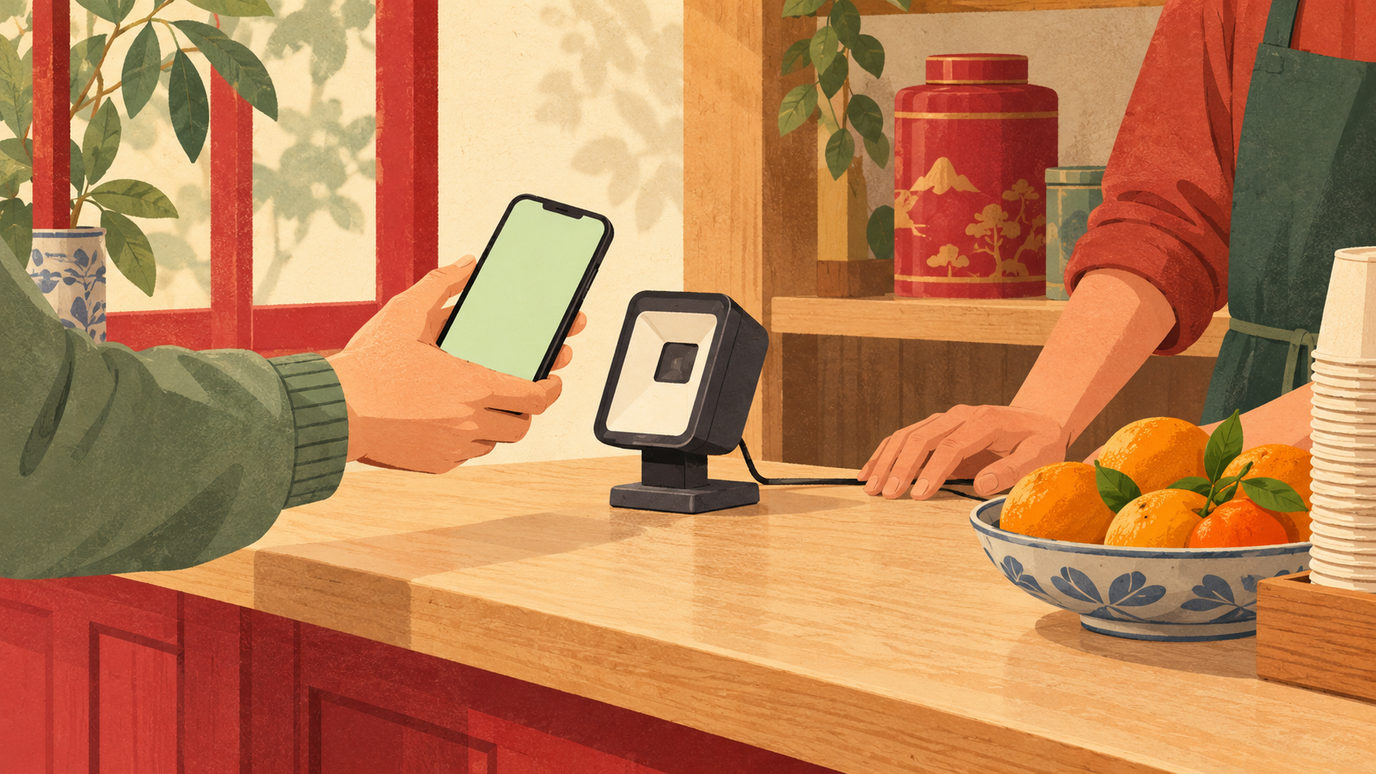
WeChat Pay and Alipay for foreigners — a hand holds a phone up to a countertop scanner at a Chinese shop counter, while the shopkeeper’s hand rests on the timber beside a bowl of oranges and a stack of cups.
Step 1

Before you fly

WeChat Pay and Alipay for foreigners used to mean a Chinese bank account. It does not any more: both apps take foreign cards, and neither needs one. That is the single biggest change of the last few years and it is why advice written before 2024 is worth ignoring. Visa, Mastercard and Diners Club work on both; the rest of the list differs between the two apps and has kept growing — American Express, JCB, Discover and internationally issued UnionPay have all been added somewhere along the way. If you carry anything other than Visa or Mastercard, try it in both apps before you decide one of them has refused you.

Do the setup at home. Verification wants a passport photo and a working phone number, and both are easier on your own wi-fi than in an airport queue. Install both apps, not one — they are not interchangeable, and which one a particular stall accepts is not predictable.

Fees and transaction limits change, and the figures repeated across travel blogs do not match what either company publishes. Alipay’s own Tour Pass agreement says the rate and the fee are determined by Bank of Shanghai, on its own or jointly with the card organisation or your issuer — not set by Alipay. So check the current terms in the app at the time you travel rather than trusting a number in an article, including this one.

Step 2

The two QR codes, and why it matters

This is the thing that catches everyone, and it is a language problem disguised as a technology problem. Every guide to WeChat Pay and Alipay for foreigners tells you to install the apps; almost none of them tell you this. There are two different QR codes and they work in opposite directions.

A WeChat Pay merchant receiving codeA printed card with the green WeChat Pay logo above a QR code, labelled 收款码, shōukuǎnmǎ. The code is an illustration and cannot be scanned.收款码shōukuǎnmǎ · WeChat PayAn Alipay merchant receiving codeA printed card with the Alipay wordmark above a QR code, labelled 收款码, shōukuǎnmǎ. The code is an illustration and cannot be scanned.收款码shōukuǎnmǎ · Alipay
Both of these are 收款码 — the vendor’s code, the kind you scan. The logo along the top is how you tell which app a counter is asking for.
YOUR CODEYour payment code. You hold up your phone showing a QR code and the vendor’s scanner reads it.YOUR CODE付款码fùkuǎnmǎyouthemTHEY SCAN YOUShops, supermarkets, chainsTHEIR CODETheir receiving code. A printed square is taped to the counter; you point your phone camera at it and type the amount yourself.THEIR CODE收款码shōukuǎnmǎthemyouYOU SCAN THEMMarket stalls, small restaurants, taxis
Which way the code points is the whole difference. Ask 我扫你还是你扫我?and the answer settles it in two seconds.

Get this the wrong way round and you will stand there holding up a code at someone who is holding up a code back at you. Hence the most useful sentence on this page: 我扫你还是你扫我? — do I scan you, or you scan me?

Step 3

What to actually say

Ten phrases covering the whole transaction, from asking whether an app is accepted to sorting out a payment that has not landed. The tone marks are coloured so you can see the shape of each syllable before you say it.

Four customers at the open counter of a Beijing food shop. One woman holds her phone flat against the merchant’s scanner while another waits with her phone already out; behind the glass, chilled trays and a green price board reading 8元 a cup.
可以用支付宝吗?Kěyǐ yòng Zhīfùbǎo ma?Can I use Alipay?Opening question at any till.
可以用微信支付吗?Kěyǐ yòng Wēixìn zhīfù ma?Can I use WeChat Pay?The same question, other app.
我扫你还是你扫我?Wǒ sǎo nǐ háishi nǐ sǎo wǒ?Do I scan you, or you scan me?Settles it in two seconds.
扫这里Sǎo zhèlǐScan here.Said to you, usually with a finger pointing.
付好了Fù hǎo leIt’s paid.You have paid and the screen shows it.
没收到Méi shōu dàoIt hasn’t come through.Said by them. Do not walk away yet.
再试一次Zài shì yí cìLet’s try again.Defuses the queue.
网不好Wǎng bù hǎoThe signal is bad.Nine times in ten, this is the real problem.
能刷卡吗?Néng shuākǎ ma?Can I use a card?The fallback. Often no.
可以用现金吗?Kěyǐ yòng xiànjīn ma?Can I pay cash?Legal everywhere. Welcome almost nowhere.
Step 4

When it goes wrong

Payments fail in China for boring reasons, and almost always the same three.

网不好wǎng bù hǎo

The signal is bad

Inside a shopping centre or a basement, almost always. Say it and everyone will nod — it is the most common cause by a distance.

额度édù

Your daily limit is reached

Silent, and it looks exactly like a declined card. Check the app rather than assuming the payment method is wrong.

银行yínháng

Your bank at home blocked it

An unfamiliar merchant in an unfamiliar country. Tell them you are travelling before you go and this one disappears.

If a vendor says 没收到 — it has not come through — do not pay a second time until you have checked your own transaction list. Duplicate payments are common, getting the money back is slow, and you will be doing it in Mandarin.

Carry a few hundred yuan anyway. Cash has never once needed a signal, and a vendor cannot refuse it — see the last question below.

WeChat Pay and Alipay for foreigners

FAQs

Yes. Both take foreign cards linked directly in the app. Visa, Mastercard and Diners Club work on either; the rest of the list differs between the two apps and has kept growing, so try both before concluding your card is the problem. This changed within the last couple of years, so older guides saying you need a Chinese account are out of date.
Both. They are not interchangeable and acceptance is genuinely unpredictable: a restaurant may take one and the stall outside it the other. Installing both takes an extra ten minutes at home and removes the problem entirely.
They change, and they are not what most travel articles claim. Alipay states that the rate and fee on its Tour Pass product are determined by Bank of Shanghai, on its own or jointly with the card organisation or your issuer, rather than published as a fixed rate. So the only reliable answer is the one shown in your app at the time you travel.
Rarely, but carry some. Two or three hundred yuan covers the cases mobile payment does not: a dead phone, a basement with no signal, an elderly vendor who has never used a QR code. Refusing cash is not allowed either: PBoC Announcement No. 10 [2018] bars businesses from turning it away, and the central bank has fined firms that did.
没收到 (méi shōu dào) is what they will say to you — it has not come through. Answer with 再试一次 (zài shì yí cì), let’s try again, or 网不好 (wǎng bù hǎo), the signal is bad. Check your own transaction list before paying twice.

Going to China sooner than you’d like to be ready for?

The Traveller course covers exactly this — payments, taxis, hotels, ordering — in the order you will actually meet them. One-to-one, and we start from wherever you are.

See the Traveller course