
By 2030, the world’s economic centre of gravity will have shifted east. Major institutions — Goldman Sachs, PwC and the IMF — disagree on the exact year China overtakes the United States as the world’s largest economy by GDP. They agree on the direction.
The professionals who’ll capture the most upside from that shift aren’t the ones who can read about it in the Financial Times. They’re the ones who can speak about it in a Beijing boardroom — without an interpreter.
If you’re a professional in finance, technology, manufacturing, law or consulting, Mandarin for business is no longer a niche language skill. It’s a career multiplier. And the supply of business-fluent Mandarin speakers among non-Chinese professionals is, to put it bluntly, tiny — while demand is large and growing structurally.
This is a guide to what Mandarin actually unlocks in a modern career — what it costs to acquire, what it returns, and the specific moments where speaking the language separates the people who lead the China-facing work from the people who watch it from the sidelines.
The career landscape no one is preparing for
China is the world’s second-largest economy, the largest manufacturer on the planet, and the biggest trading partner of more than 120 countries. A growing share of the Fortune Global 500 is headquartered in Beijing, Shanghai and Shenzhen. Chinese private equity, sovereign capital and family offices are increasingly significant in global deal flow.
And yet, outside specialised diplomatic and academic circles, the number of Western professionals who can negotiate, present or socialise in Mandarin remains vanishingly small.
This isn’t because Mandarin doesn’t matter. It’s because, until recently, most professionals could afford to outsource the language to an interpreter. That worked when China was a destination market that Western companies sold into. It works much less well now that Chinese companies, capital and consumers are increasingly upstream in your supply chain, on your cap table, or sitting on the other side of the negotiating table.
What Mandarin actually unlocks in your career
Mandarin for business isn’t a niche credential. It’s a multiplier that lands across four career levers at once:
1. Salary uplift
Roles that explicitly value Mandarin — China-facing positions, cross-border deal work, Asia-Pacific leadership tracks — consistently command meaningful salary premiums over comparable roles without the language requirement. Industry research from sources like The Economist and global recruiters has placed the premium anywhere from 15 to 30 per cent depending on sector and seniority. Even in positions where Mandarin isn’t required in the job description, candidates who bring it as a credential routinely command higher offers and faster promotion timelines.
2. Internal mobility
Multinationals constantly need senior people who can sit in front of Chinese partners, regulators or customers without an interpreter. If you’re already inside a company with any China exposure — and increasingly, most are — Mandarin is one of the fastest paths to a regional remit, an APAC promotion, or a strategic project that puts you in front of executive leadership.
3. Optics with senior leadership
Right or wrong, learning Mandarin signals long-term thinking, intellectual ambition and commercial seriousness. It positions you as someone who is investing in their own ceiling. Senior leaders notice that — and they remember it when promotion conversations come around.
4. The rarity premium
The supply of business-fluent Mandarin speakers among non-Chinese professionals is tiny. Demand — from private equity funds, technology companies, manufacturers, law firms, management consultancies and family offices — is large, structural and growing. Rarity in any high-value skill is a career moat. Rarity in Mandarin, against a backdrop of expanding Chinese economic influence, is one of the strongest moats currently available to a Western professional.
Five career moments where Mandarin pays off
Abstract claims about “Asia opportunity” don’t motivate anyone. Here’s what Mandarin actually does for your career, in five concrete moments:
Closing a deal in Beijing
Negotiations in Chinese business culture don’t end at the contract. They’re built on trust — trust that is largely established at dinners, lunches and informal conversations in Mandarin. The deals that close are usually closed by the side that has built the deeper relationship, and that relationship is rarely built through an interpreter. If you’d like a deeper read on the regional cultural backdrop, our Explore China guide breaks down how business culture differs across China’s 34 provinces and regions.
Building rapport with a Shanghai private-equity fund
When a portfolio company is preparing to raise from Chinese capital, the partner who can join the kick-off call and exchange a few well-placed Mandarin pleasantries earns visible trust from the first minute. The interpreter stays for the technical detail — but the relationship has already started, and it stays personal long after the deal closes.
Leading a Shenzhen factory walkthrough
Manufacturing relationships live or die on the strength of supplier relationships. The engineer, operations lead or sourcing executive who can speak directly to the factory floor — even at a basic conversational level — closes the trust gap no interpreter can. Suppliers behave differently when the person paying them can ask their own questions.
Negotiating IP licensing or joint-venture terms
Mandarin contractual nuance doesn’t translate cleanly. The difference between 合作 (hézuò, cooperation) and 合资 (hézí, joint venture) is a different commercial relationship. The way the word 诚意 (chéngyì, sincerity) frames a Chinese negotiation has no English equivalent. A team member who can hear those nuances in real time has an edge that no post-meeting translation memo can replicate. Our Chinese radicals chart is the entry point if you’d like to start building the character-recognition skill that helps with contract reading.
Hosting a Chinese delegation
When senior Chinese visitors arrive at your office, someone in the host team needs to deliver the welcome remarks, the toast at the dinner, and the closing thank-you. That person is visibly important to both sides. They become the relationship anchor for the next deal, the next visit and often the next promotion.
A composite student story
A Sydney-based corporate lawyer at one of the major Australian firms started 1-on-1 Mandarin lessons after being repeatedly excluded from China-facing deal teams. She wasn’t aiming for fluency — she was aiming to stop being the obvious person to leave behind.
After eight months of consistent lessons, she joined a delegation to Shanghai for a joint-venture negotiation, initially as a junior in the room. By the second day, she was the one exchanging informal Mandarin asides during the coffee breaks — not handling the legal substance, but visibly part of the relationship. Within eighteen months, she had been promoted into the firm’s Asia practice.
The lesson isn’t that Mandarin alone wins the promotion. It’s that Mandarin removes the obvious reason to leave you out of the deal team in the first place — and once you’re in the room, the rest of your career compounds from there.
“But isn’t Mandarin too hard for adults?”
This is the most common professional objection to learning Mandarin — and it is largely wrong. We’ve written a full breakdown of this in How to Learn Mandarin as an Adult, but the short answer follows.
Mandarin has a reputation as one of the hardest languages for English speakers. That reputation comes mostly from the writing system — and largely doesn’t apply to career-relevant Mandarin.
For business purposes, you don’t need to read 4,000+ characters. You need:
- Confident pronunciation, including the four tones — our free tones cheatsheet is the entry point
- A working core of high-frequency professional vocabulary
- Functional grammar — and Mandarin grammar is, frankly, simpler than most European languages. No conjugations. No gendered nouns. No tenses in the European sense.
- Listening calibration to native pace
Most professionals significantly overestimate how long it takes to reach the level where Mandarin starts paying off in the room. The “too hard” myth is, in practice, the biggest obstacle — not the language itself.
How long it actually takes to be career-useful
With two to three hours of weekly 1-on-1 lessons plus daily exposure, the realistic milestones look like this:
For most professionals, “career-useful” Mandarin lands somewhere between months six and twelve — far sooner than the years most people assume. For a deeper read, see our full piece on how long Mandarin actually takes.
Where to start without quitting your job
You don’t need a sabbatical, an immersion programme, or two free hours every day. You need consistent, targeted lessons that fit around a working week, and three things in particular:
1. 1-on-1 lessons with a native teacher
Apps and group classes are fine for casual learners. For career-targeted Mandarin, you need a teacher who can correct your tones in real time, adapt the vocabulary to your industry, and pace the lessons around your actual career timeline. Our guide to choosing a Mandarin teacher walks through what to look for.
2. Industry-specific vocabulary
Generic Mandarin courses won’t teach you the words a deal lawyer, fund manager or supply-chain executive actually uses. A tailored curriculum is what makes the difference between “I learned some Chinese once” and “I can hold my own in a deal room.”
3. Cultural fluency, not just linguistic
The vocabulary is half the job. Understanding the structure of a Chinese business meeting, how rapport is built, what indirect signals mean, what’s tasteful and what isn’t — this is what gets deals done. A teacher who’s been in those rooms can teach you what a textbook can’t.
The compounding career advantage
The hardest part of learning Mandarin is starting. The career advantage compounds from there.
Every China-adjacent project that arrives in your industry — a new client, a new market, a new partner — becomes accessible to you in a way it isn’t to colleagues who can’t bridge the language gap. Over a decade, that’s the difference between watching the Asia practice grow from the outside and being one of the people leading it.
Most professionals never start because the upfront commitment feels disproportionate to the payoff. The mathematics are actually the other way around: a few hundred hours of focused study, spread across eighteen to twenty-four months, in exchange for two or three decades of expanded career options. There aren’t many investments in your professional life that return at that rate.
The version of your career that includes business-fluent Mandarin is meaningfully larger than the version that doesn’t.
Free to read. This is where the reading starts.
The 214 Radicals Complete Pack
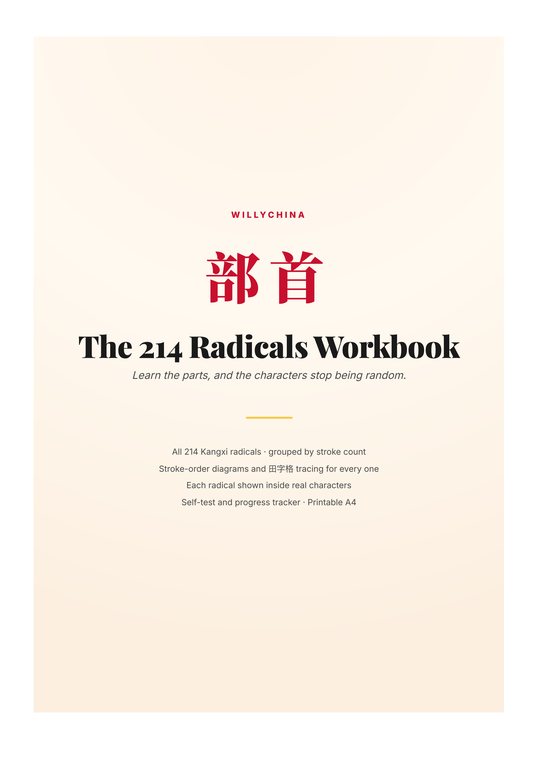
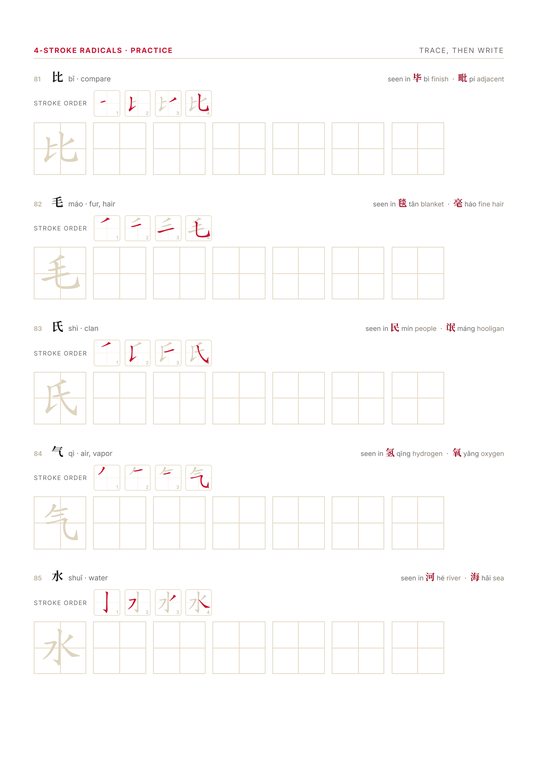
Reading Chinese at work begins with the 214 parts every character is built from. The Complete Pack covers all of them — a 69-page workbook with stroke order and 田字格 tracing, each radical shown inside real characters, 830 audio files and three Anki decks.
See what is inside — US$32 →One payment · instant download · yours to keep
FAQs
With 2–3 hours of weekly 1-on-1 lessons plus daily exposure, most professionals reach a confident introduction and basic small talk at around the three- to six-month mark, and meaningful business conversation between months nine and twelve. Negotiating in Mandarin for routine matters typically lands in the eighteen-to-twenty-four-month window. The first observable career upside — being included in meetings you previously wouldn’t have been — usually starts well before any of those milestones.
For spoken business Mandarin — meetings, dinners, presentations, phone calls — no. Pinyin (the romanised pronunciation system) plus a working spoken vocabulary is enough to be functional. Characters become more useful once you start reading contracts, signing documents, or wanting to recognise company names on signage. Many of our students start with spoken-only and add characters in year two.
Yes, in two ways. First, the vocabulary diverges quickly: a beginner course teaches you food, family and travel. A business course teaches negotiation language, meeting protocol, contractual nuance and industry-specific terminology. Second, the cultural framing is different. Chinese business culture has its own conventions around hierarchy, indirectness, trust-building and timing that don’t appear in a general Mandarin curriculum. Our Business Mandarin course is built around both.
Almost all of our students are working professionals, many in senior roles. Lessons are scheduled around your week (early mornings, evenings or weekends), each is 60 minutes, and there are no lock-in contracts — so you can scale up or pause as your workload demands. Most students settle into a rhythm of one or two lessons per week plus 15–20 minutes of daily review.
The free 30-minute intro call. We’ll talk through your industry, your goals and your timeline, and design a 12-month learning path that’s specific to your career — not a generic curriculum. If you’re absolutely new to Mandarin, the first lessons will cover pinyin and tones; if you have some Mandarin already, we’ll assess your level and pick up from there.
WillyChina runs 1-on-1 online Mandarin lessons by native and professional teachers — from beginner pronunciation to business-grade negotiation language. If you’d like to talk through how Mandarin could fit into your specific career, the free 30-minute intro call is the right place to start.