There are hundreds of apps that claim to teach you Mandarin Chinese. Some are excellent. Some are a waste of your time. And almost all of them share one important limitation that most reviewers won’t tell you about.
This guide gives you an honest, practical breakdown of the best Mandarin apps available to Australian learners right now — what each one is genuinely good for, and how to use them alongside lessons to make real progress.
The One Thing No App Can Do
Before we get into the apps, there’s something worth understanding. Every Mandarin app on this list has the same fundamental weakness: it cannot hear you speak, correct your tones, or tell you when you’re developing a bad habit.
Tones are the most critical element of Mandarin pronunciation. The same syllable — “ma” — means mother, hemp, horse, or scold depending on how you pitch it. Getting tones wrong doesn’t just sound a little off; it changes the meaning of what you’re saying entirely.
Apps use speech recognition to check pronunciation, but it’s nowhere near good enough to catch the subtle tonal errors that a qualified teacher spots in seconds. Learners who rely solely on apps often build ingrained pronunciation habits that take months to fix later.
The most effective approach — and the one I recommend to every student — is to use apps as a daily supplement to proper lessons, not as a replacement. With that said, the right apps genuinely accelerate your progress. Here’s what’s worth your time.
The Best Mandarin Apps for Australian Learners
1. HelloChinese — Best for Structured Beginner Learning
Free (with paid Premium tier) | iOS & Android
HelloChinese is consistently the most recommended app for Mandarin beginners, and for good reason. Unlike Duolingo, which adapts its Mandarin course from a generic language-learning template, HelloChinese was built specifically for Mandarin. The tone training is genuinely good — it teaches all four tones with audio examples and visual pitch diagrams that actually make sense.
The structured course takes you from zero through the equivalent of HSK 1–2 level, covering Pinyin, tones, vocabulary, grammar patterns, and basic characters. Lessons are short (5–10 minutes), which makes it realistic to fit into a busy day.
Best Used For
Daily vocabulary and grammar practice between lessons. Particularly good for reinforcing what your teacher covers in sessions.
2. Pleco — The Essential Mandarin Dictionary
Free (with paid add-ons) | iOS & Android
If you only download one app, make it Pleco. It’s not a learning app in the traditional sense — it’s a comprehensive Chinese dictionary that every serious Mandarin learner uses as a daily tool.
Type or draw any character, scan text with your camera, and Pleco gives you the meaning, Pinyin pronunciation, stroke order, example sentences, and audio. The built-in flashcard system uses spaced repetition, which is one of the most effective methods for vocabulary retention.
The free version is exceptional. Paid add-ons include premium dictionaries and advanced flashcard features, but most learners never need them.
Best Used For
Looking up new vocabulary in real time, building a personal word bank, and reading practice. An indispensable reference tool at every level.
3. Duolingo — Best for Building a Daily Habit
Free (with paid Plus tier) | iOS & Android
Duolingo gets a lot of criticism from serious language learners, and some of it is fair — the Mandarin course is less rigorous than HelloChinese, and its gamified format can give a false sense of progress. But Duolingo does one thing extremely well: it keeps you coming back every day.
The streak mechanic and short lessons (3–5 minutes) make it the easiest app to use consistently. For busy Australians who struggle to find study time, Duolingo is often the difference between practising daily and not practising at all.
Use it for what it’s good at — vocabulary exposure and daily habit reinforcement — rather than expecting it to teach you Mandarin on its own.
Best Used For
Maintaining a daily study streak and vocabulary exposure, especially in short commutes or breaks.
4. Anki — Best for Vocabulary Retention
Free on Android / $44 one-time on iOS | Desktop free
Anki is a spaced repetition flashcard system used by medical students, lawyers, and language learners worldwide — and for Mandarin in particular, it’s extraordinarily effective.
Unlike apps that decide what you review, Anki shows you cards at precisely the moment you’re about to forget them. The result is that vocabulary sticks permanently rather than fading after a week. There are thousands of free Mandarin decks available — HSK vocabulary lists, common phrases, character sets — ready to download and use immediately.
The iOS app is expensive upfront ($44), but it’s a one-time purchase and it’s worth it for serious learners. The Android version and desktop app are both free.
Best Used For
Locking in HSK vocabulary, character recognition, and any new words your teacher introduces in lessons. 15–20 minutes of Anki daily has an outsized impact on long-term retention.
5. Skritter — Best for Learning to Write Characters
Free trial, then subscription | iOS & Android
If your goals include reading and writing Chinese characters — useful for HSK written exams, business correspondence, or simply engaging more deeply with Chinese culture — Skritter is the best app for it.
You trace characters on screen and Skritter analyses your stroke order and accuracy, correcting mistakes in real time. The spaced repetition system ensures you review characters at the right intervals to build lasting memory. It also covers Pinyin and tone practice.
It’s the most specialised app on this list, so it’s not for everyone. But for learners working towards HSK 3 and above, or anyone who wants to develop genuine reading ability, it’s invaluable.
Best Used For
Character writing practice for HSK candidates and intermediate learners. Pairs well with the HSK Preparation course. For a fully free alternative, try our own Chinese Writing Practice tool — stroke-order coaching on a real 米字格 grid, spaced-repetition review, and printable PDF worksheets, with no sign-up required.
6. ChinesePod — Best for Listening and Conversation Skills
Free (limited) / Subscription | iOS, Android & Web
ChinesePod takes a podcast-based approach to learning Mandarin. Short audio lessons cover real-life scenarios — ordering food, taking taxis, business meetings — delivered by native speakers with English explanations. The listening practice is excellent and the content is genuinely useful for real-world situations.
The free tier gives access to a limited number of lessons. The full library requires a subscription, but the quality justifies it for intermediate learners who want to develop natural listening comprehension beyond what a textbook provides.
Best Used For
Commuting or exercising — passive listening that trains your ear to natural Mandarin speech patterns. Particularly useful for travellers preparing for a trip to China.
How to Use Apps Effectively Alongside Lessons
The learners who progress fastest are those who treat apps as daily reinforcement rather than the main event. Here’s a practical routine that works well for most adult learners:
Morning (5–10 min)
Anki flashcard review — lock in vocabulary from your last lesson.
Commute or Lunch (10–15 min)
HelloChinese or Duolingo — structured practice and new vocabulary exposure.
During the Day
Pleco open on your phone — look up any Mandarin you encounter.
Evening After Lessons
Skritter (if you’re working on characters) or ChinesePod for passive listening.
This approach means you’re engaging with Mandarin every day, reinforcing what your teacher covers, and building vocabulary — all without needing more than 30 minutes outside of lessons.
A Note for Australian Learners
All six apps listed here are available on the Australian App Store and Google Play. A few practical notes:
Travelling to China?
Download Pleco and your Anki decks for offline use before you go — many apps require internet access that may be unreliable or restricted in mainland China.
Data Privacy
Duolingo and HelloChinese collect usage data as standard. If data privacy is a concern, Anki and Pleco store everything locally on your device.
HSK Exam Prep
Anki (with an HSK vocabulary deck) and Skritter are the most directly useful apps for students preparing for the HSK exam in Australia. Pair these with structured preparation — read our guide to how long it takes to reach HSK level.
The Bottom Line
The best Mandarin apps are genuinely useful tools — they keep you engaged daily, build vocabulary, and complement structured learning. But they work best when paired with real lessons from a qualified teacher who can correct your tones, adapt to your goals, and keep you on track.
If you’re just starting out, learning Mandarin as an adult is absolutely achievable — and the right combination of lessons and daily app practice is the fastest way to get there.
FAQs
Can I learn Mandarin with just an app?
You can learn some vocabulary and basic phrases, but apps cannot teach you correct tones or give you feedback on your pronunciation — both of which are essential in Mandarin. Most people who rely solely on apps plateau quickly. Apps work best as a daily supplement to lessons with a qualified teacher.
Is HelloChinese better than Duolingo for Mandarin?
Yes, for Mandarin specifically. HelloChinese was built from the ground up for Chinese learners, with better tone training and a more structured curriculum. Duolingo’s Mandarin course is less rigorous, but its gamification makes it easier to use consistently. Many learners use both.
Is Pleco free?
Yes — the core Pleco app and dictionary are completely free and excellent. Paid add-ons are available for premium dictionaries and advanced features, but the free version is more than sufficient for most learners.
Which apps work best for HSK preparation?
Anki (with an HSK vocabulary deck) and Skritter are the most directly useful for HSK candidates. Anki helps you memorise the vocabulary lists, while Skritter builds the character writing skills required for the written exam.
Do these apps work offline?
Pleco and Anki both work fully offline once downloaded — important if you’re travelling to mainland China where internet access can be restricted. Duolingo, HelloChinese, and Skritter require an internet connection for most features.
Recommended Books to Pair With Your Apps
Apps work best alongside a solid textbook or reference. Here are the resources I recommend to students who want to go further:
- Integrated Chinese — the most widely used Mandarin textbook series
- HSK Standard Course books — essential for working toward HSK exams
- Chinese Character Writing Workbook — pairs perfectly with Skritter
- Chineasy by ShaoLan — a visual introduction to Chinese characters
This post contains affiliate links. If you purchase through them, I may earn a small commission — at no extra cost to you.
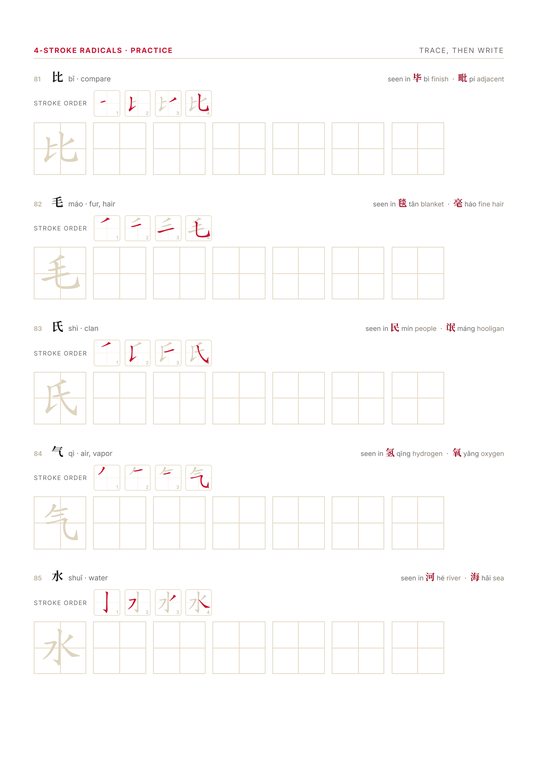
No app on this list teaches handwriting properly.
The 214 Radicals Complete Pack
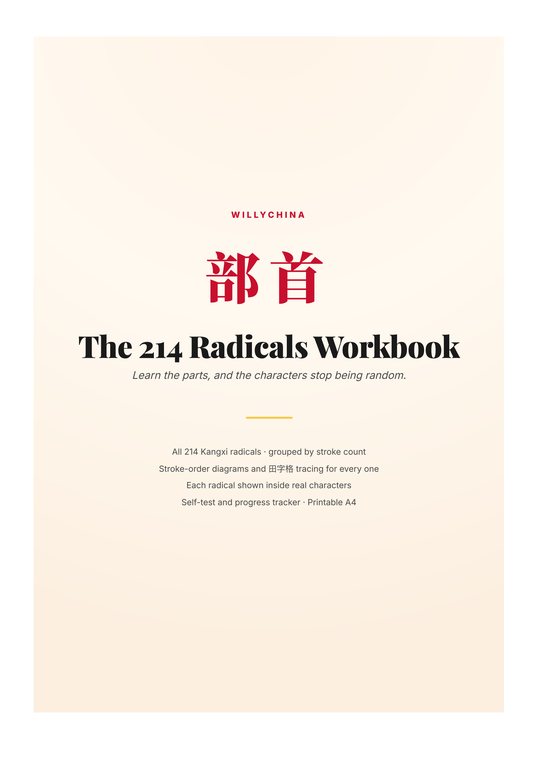
That is the one gap every app here leaves. The 214 Radicals Complete Pack is a 69-page workbook with stroke-order diagrams and 田字格 tracing for all 214 radicals, each shown inside real characters, plus 830 audio files and three Anki decks.
See what is inside — US$32 →One payment · instant download · yours to keep