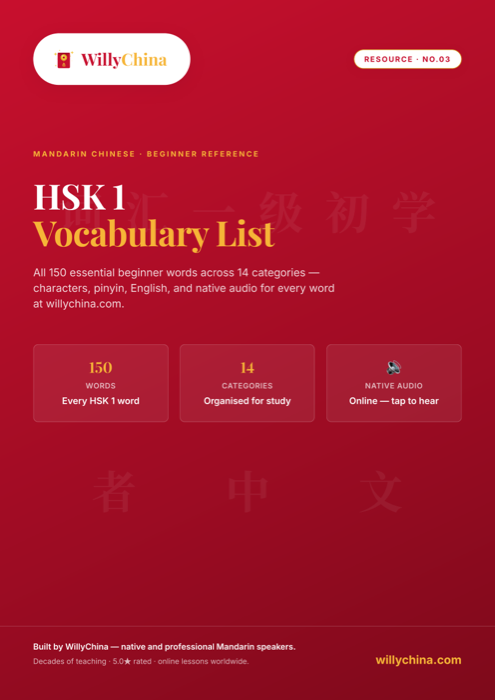
HSK 1 Vocabulary List
All 150 essential HSK 1 words organised by category — characters, pinyin, English meaning, and native pronunciation for every word. Tap any word below to hear it spoken by a native Mandarin teacher.
⬇ Download PDF (5 pages)- All 150 HSK 1 vocabulary words
- Organised across 14 categories for structured study
- Character + pinyin + English meaning for each word
- Search + filter by category on the page
- Native pronunciation audio for every word
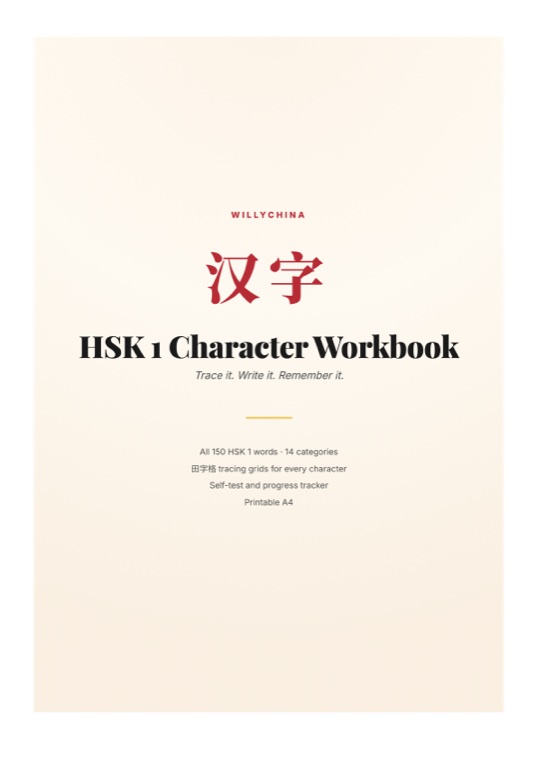
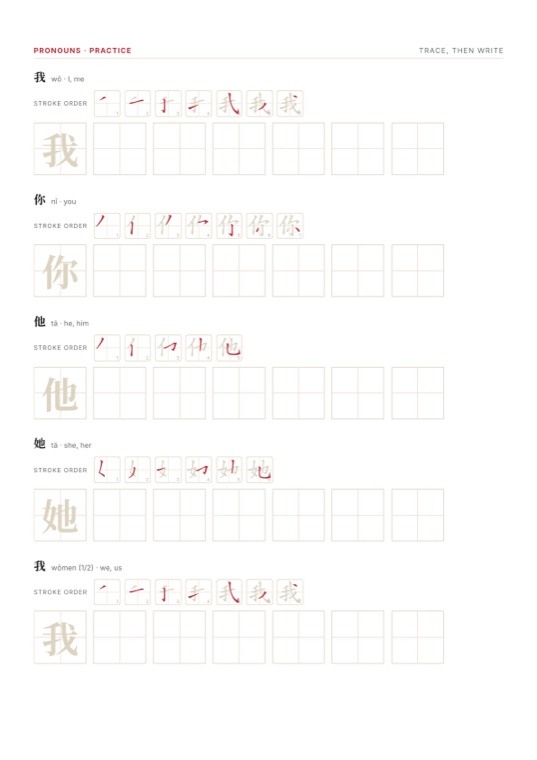
The list above is free. This is the practice.
HSK 1 Complete Pack
A 70-page character workbook with 田字格 tracing grids for all 150 words, 300 audio files at natural and slow speed, and Anki flashcards in both directions.
See what is inside — US$32 →One payment · instant download · yours to keep
Tap any word to hear it spoken
Search by character, pinyin or English meaning. Filter by category. Tap any card to hear native Mandarin pronunciation.
No words match your search. Try a different term or clear filters.
What is HSK 1?
If you’ve just started learning Mandarin Chinese, the HSK 1 word list is your first practical milestone. Master these 150 words and you can hold a simple conversation about yourself, your family, where you live, what you eat, basic actions and feelings. It’s also the official benchmark that recognised globally — passing the HSK 1 exam proves you can survive a basic Mandarin interaction.
This resource gives you the entire HSK 1 vocabulary in three forms: a downloadable A4 PDF organised by category for offline study and printing, an interactive search-and-filter web grid (above) for quick lookup, and native pronunciation audio for every single word powered by Microsoft Xiaoxiao neural TTS.
How to use this list
Don’t try to memorise all 150 words at once. Studies of vocabulary acquisition consistently show that spaced repetition + audio + sentence context is what makes words stick — not flashcard cramming. Here’s how to actually learn HSK 1 vocabulary:
- Print the PDF and stick it on your wall or fridge. Passive exposure adds up — you’ll glance at the categories during dead moments throughout the day.
- Use the interactive grid above for daily drills. Filter by category, tap each word to hear native pronunciation, repeat aloud. 10 minutes per day beats 1 hour once a week.
- Start with high-frequency categories: Pronouns, Numbers, Common Verbs, Greetings & Phrases, and Particles. These cover the words you’ll hear in the first sentence of every Mandarin conversation.
- Always learn words in pairs or triplets: 妈妈 / 爸爸 / 儿子 / 女儿 together — not in isolation. Related words reinforce each other.
- Build a sentence with each word. Knowing “吃 (chī, to eat)” in isolation is useless — knowing “我吃米饭 (wǒ chī mǐfàn, I eat rice)” is what gets you talking.
- Drill the homophones early. 是 (shì, to be) and 四 (sì, four) sound similar but differ in tone. Same with 买 (mǎi, buy) and 卖 (mài, sell).
If you’re targeting an actual HSK 1 exam date, drilling vocabulary alone won’t be enough — you’ll need listening practice, reading speed and exam pacing. That’s what our 1-on-1 HSK Preparation course is built for. For learners not chasing the exam, our Basics course covers the same vocabulary in conversational context.
The 14 categories explained
This list organises the 150 HSK 1 words into 14 categories. Each category covers a specific area of basic Mandarin conversation — pronouns and numbers are foundation; verbs and adjectives are what you’ll use most; greetings and particles are how Mandarin conversations actually sound.
- Pronouns + Question Words — Who you’re talking about, who you’re asking about. Learn these first.
- Numbers — Critical for prices, time, addresses, age, dates. Drill 1-10 in your first week.
- Time & Calendar — Today, tomorrow, year, hour. Combines with numbers to express dates and durations.
- Family & People — Mum, dad, friend, teacher, doctor. Daily-life vocabulary that comes up in every introduction.
- Common Verbs — The biggest category. To be, to have, to go, to eat, to like — the engines of every Mandarin sentence.
- Adjectives — Good, big, small, many, hot, cold. Simple descriptions that work everywhere.
- Greetings & Phrases — Hello, thank you, goodbye, sorry. The first words you’ll actually use with a native speaker.
- Particles & Connectors — 的, 了, 吗 — the small words that hold Mandarin grammar together.
- Common Objects — Book, money, chair, computer, phone. Concrete everyday nouns.
- Places + Directions — China, Beijing, home, school, hospital. Plus directional words like up, down, here, there.

Preparing for the HSK 1 exam?
These 150 words are the entire HSK 1 vocabulary — but the exam also tests listening, reading patterns and grammar. Our 1-on-1 HSK Preparation course drills exam-specific skills with mock papers and pacing technique.
Book a free HSK consultation →A daily study routine
Here’s a 14-day plan to lock in the entire HSK 1 list. Each day takes 15-20 minutes.
- Day 1-2: Pronouns + Question Words (17 words). Listen to every word. Repeat aloud 5 times.
- Day 3-4: Numbers + Time (21 words). Practise counting 1-10 daily.
- Day 5-7: Common Verbs (26 words — biggest category). 10 verbs per day.
- Day 8-9: Family + People + Greetings (19 words). Practise introducing yourself.
- Day 10: Places + Food (16 words). Talk about where you eat.
- Day 11: Adjectives + Directions (16 words). Describe simple things around you.
- Day 12: Particles + Measure (15 words). The grammar glue.
- Day 13: Common Objects (20 words). Concrete nouns from daily life.
- Day 14: Review entire list. Filter “All” in the grid above. Tap each word — say it before the audio plays.
By the end of week 2, you’ll have heard each word at least 5 times and be ready to start building sentences. From there, focus on grammar (the WillyChina Basics course) and you’ll be conversational in 2-3 months.
FAQs
Sources: word list from the official HSK 2.0 syllabus via Chinese Testing International; English glosses adapted from CC-CEDICT (CC BY-SA 4.0).
Want a teacher to help you nail HSK 1?
Vocabulary lists are a foundation — but you need real practice with feedback. Book a free 30-minute intro lesson.
Book a Free Intro Lesson →Free PDF
Where should I send it?
Pop your email in and the PDF is yours — it lands in your inbox straight away.
I’ll send new resources now and then, and the odd note on learning Mandarin properly. Unsubscribe from any email.
Sent. Check your inbox — your download is starting now.