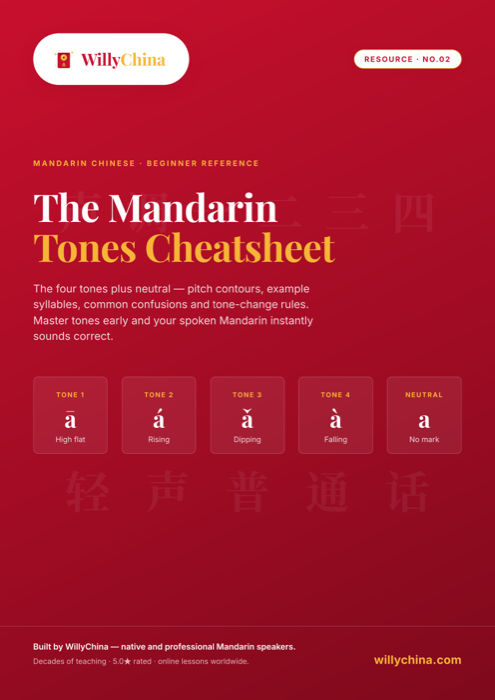
The Mandarin Tones Cheatsheet
The 4 tones plus neutral — pitch contour diagrams, the famous “ma” example, tone change rules and the most-confused pairs. Native pronunciation for every syllable, right below.
⤓ Download PDF (4 pages)- 5 pitch-contour diagrams (4 tones + neutral)
- The famous “ma” example with native audio
- Tone change (sandhi) rules for the 3rd tone, 不, and 一
- Most-confused pairs: 2nd vs 3rd, 1st vs 4th, etc.
- Drill-mode chips for instant audio practice
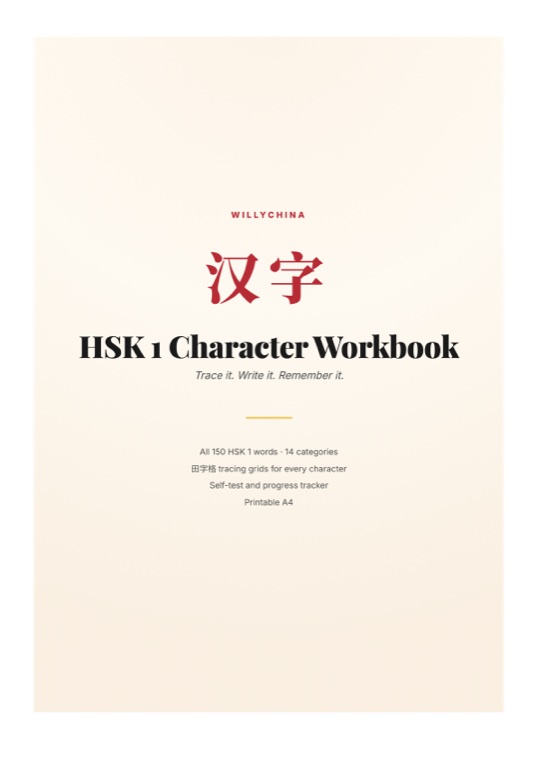
The cheatsheet above is free. This is the practice.
HSK 1 Complete Pack
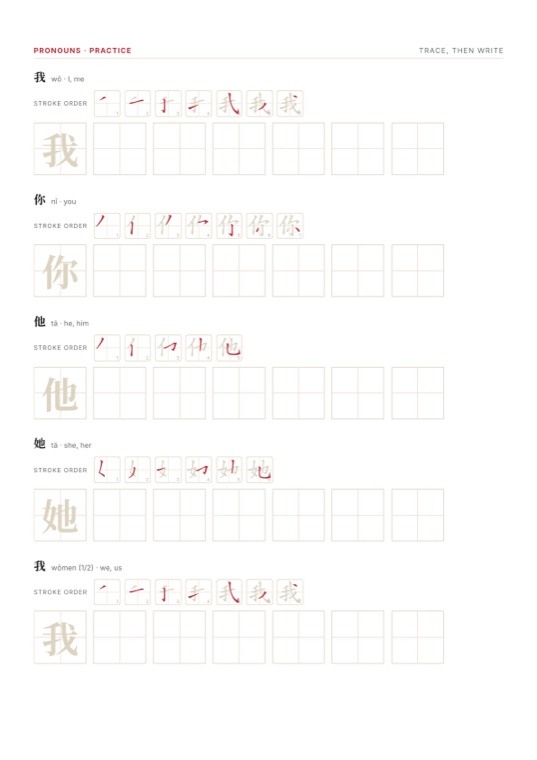
Tones only stay learned once you hear them inside real words. The HSK 1 Complete Pack gives you all 150 HSK 1 words as 300 audio files — every word at natural speed and again slowed down — plus a 70-page workbook with 田字格 tracing grids and Anki decks in both directions.
See what is inside — US$32 →One payment · instant download · yours to keep
One syllable, five tones, five meanings
Tap any card to hear native Mandarin pronunciation. The famous “ma” example — same syllable, five completely different words depending only on tone.
Drill mode — the most-confused syllables
Tap any chip to hear native pronunciation. These are the pairs and phrases learners most often mix up.
What are Mandarin tones?
Mandarin Chinese is a tonal language. Unlike English, where pitch carries emotional or grammatical information (the rising “really?” question), Mandarin uses pitch to distinguish core meaning. The syllable “ma” can mean five completely different things — mother, hemp, horse, scold, or a question particle — depending only on tone.
If you’ve used the audio drills above, you’ve just heard the difference. To English-speaking learners, the gap between tone 2 (rising) and tone 3 (dipping) can feel almost imperceptible at first — but Mandarin speakers hear them as distinct as you hear “buy” vs “sell”. Mastering tones early is the highest-leverage move in learning Mandarin online.
The 4 tones + neutral
Each Mandarin syllable carries one of five tones. The four “full” tones plus the neutral tone (no mark) cover every Mandarin word.
| Tone | Mark | Contour | Closest English analogue |
|---|---|---|---|
| Tone 1 | mā | High & flat | Holding a high note while singing |
| Tone 2 | má | Rising | Asking “Really?” in surprise |
| Tone 3 | mǎ | Dipping (low — then rising) | Saying “Hmm…” while thinking, then “Yeah” |
| Tone 4 | mà | Sharp falling | An angry “STOP!” |
| Neutral | ma | Light, short, no contour | The unstressed second syllable in “sofa” |
The contour diagrams in the PDF — and in the audio cards above — visualise the pitch movement of each tone. Tone 1 is a horizontal line. Tone 2 is a clean rise. Tone 3 dips low first, then rises (in fast speech, often just the dip). Tone 4 is a sharp downward swoop. Neutral has no contour — it’s just a short, soft syllable.
Why tones matter more than you think
Many English-speaking beginners treat tones as optional — an accent you can mostly ignore. They aren’t. Mandarin has only around 400 unique syllables (compared to over 12,000 in English), so a single syllable like “ma” must do five different jobs depending on tone. Drop tones, and your Mandarin becomes ambiguous or unintelligible.
The famous “shuǐjiǎo vs shuìjiào” pair (try them in the drill above) illustrates this perfectly. Same vowels, same consonants — entirely different meaning. shuǐjiǎo (3rd + 3rd) = dumplings. shuìjiào (4th + 4th) = to sleep. Mixing them up at a restaurant in Beijing produces some confused stares.
Master tones in the first few weeks of learning and everything downstream gets easier — vocabulary sticks better, listening comprehension improves, and your spoken Mandarin actually sounds correct to native ears.
Tone change rules (sandhi)
Mandarin tones don’t always stay fixed — certain combinations trigger automatic tone changes called sandhi. Three rules cover 95% of what you’ll hear.
Rule 1 — Two 3rd tones in a row
When two 3rd-tone syllables meet, the first becomes a 2nd tone. The written tone marks don’t change, but the pronunciation does. So nǐ hǎo (you good = hello) is actually pronounced ní hǎo.
Rule 2 — “Bù” (不, not)
“Bù” is normally a 4th tone. When followed by another 4th tone, it shifts to 2nd tone. Bù + bào (not + newspaper) becomes bú bào.
Rule 3 — “Yī” (一, one)
“Yī” is normally a 1st tone. Before 1st, 2nd, or 3rd tones it shifts to 4th tone. Before another 4th tone it shifts to 2nd tone. Stays 1st tone only when standing alone or counting.
These rules sound mechanical written out, but native speakers apply them automatically. After enough listening, you’ll start doing the same.
Most-confused tone pairs
After teaching hundreds of beginners online, here are the four tone confusions that come up most. The drill chips at the top of this page include the classic examples — play them back-to-back to train your ear.
- 2nd vs 3rd: The classic confusion. 2nd tone is a clean rise. 3rd tone dips down first, then rises. In fast speech, the 3rd tone often only dips — making it sound flat. Listen for that initial low point.
- 1st vs 4th: 1st is a steady HOLD at high pitch. 4th starts high and falls sharply. The fall is the giveaway.
- 3rd vs 4th: Both descend at the start. Only 3rd rises at the end. If you hear the rise, it’s 3rd.
- No-tone vs Neutral: Neutral tone (no mark) is still a meaningful tone — it’s short and unstressed. Don’t read it as a flat 1st tone.
If you’d like a native teacher to listen for the actual tone contour you’re producing — and correct the third-tone dip in real time — that’s the foundation of our 1-on-1 beginner Mandarin course.

Want a native teacher to actually hear your tones?
Tone accuracy is exactly what we drill in the first lessons of our 1-on-1 beginner Mandarin course. Will catches the wrong-tone habits that flashcards never can.
Book a free 30-min intro →How to practise tones daily
Tones are a muscle. Daily drilling is the only thing that builds them. Here’s the routine WillyChina recommends to every beginner:
- Drill the 5 “ma” examples daily. Play each tone above, then say it back. Do it for 60 seconds. After a week, you should produce all five without hesitation.
- Always practise with audio. Native recordings are non-negotiable — we use Microsoft Xiaoxiao here, but Pleco, HelloChinese, and ChinesePod all have native audio. Silent practice teaches you the wrong sounds.
- Record yourself and compare. Your self-perception of your own tones is unreliable. Recording forces honesty.
- Drill the confused pairs first. 2nd/3rd, 1st/4th, 3rd/4th. Use the drill chips above. Two weeks of this saves months of being misunderstood.
- Treat sandhi as automatic. Don’t try to memorise the rules — just listen for the pattern in real speech.
- Get a teacher to listen. Tones are the one thing self-study apps genuinely can’t correct. A native ear catches mistakes you can’t hear yourself.
FAQs
Want a teacher to fix your tones?
The audio drills are great — but a native ear catches mistakes you can’t hear yourself. Book a free 30-minute intro lesson.
Book a Free Intro Lesson →Free PDF
Where should I send it?
Pop your email in and the PDF is yours — it lands in your inbox straight away.
I’ll send new resources now and then, and the odd note on learning Mandarin properly. Unsubscribe from any email.
Sent. Check your inbox — your download is starting now.