Complete Pinyin Chart — Mandarin Chinese PDF
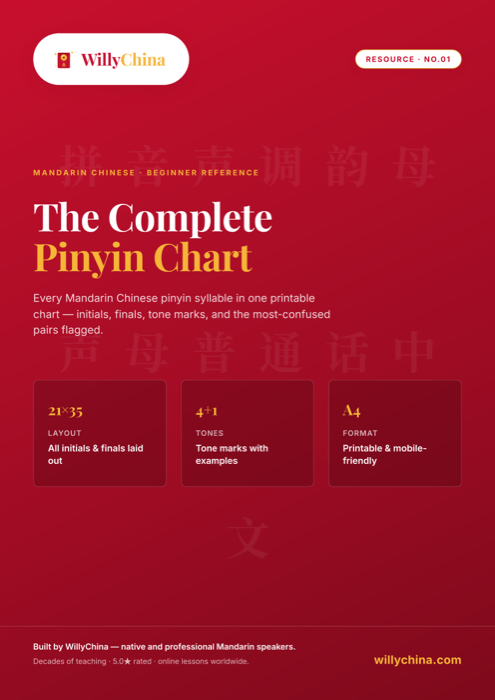
Every Mandarin Chinese pinyin syllable in one printable A4 chart. Initials, finals, tone marks and the most-confused pairs flagged in red — perfect for beginners and HSK 1 prep.
⤓ Download PDF (4 pages)- All 21 initials × 35 finals laid out clearly
- Tone-mark guide (1st, 2nd, 3rd, 4th + neutral)
- Common confusion pairs (zh/z, ch/c, sh/s) highlighted
- A4 printable + retina mobile-friendly preview
- Selectable, copy-pasteable text inside the PDF
The chart above is free. This is the practice.
HSK 1 Complete Pack
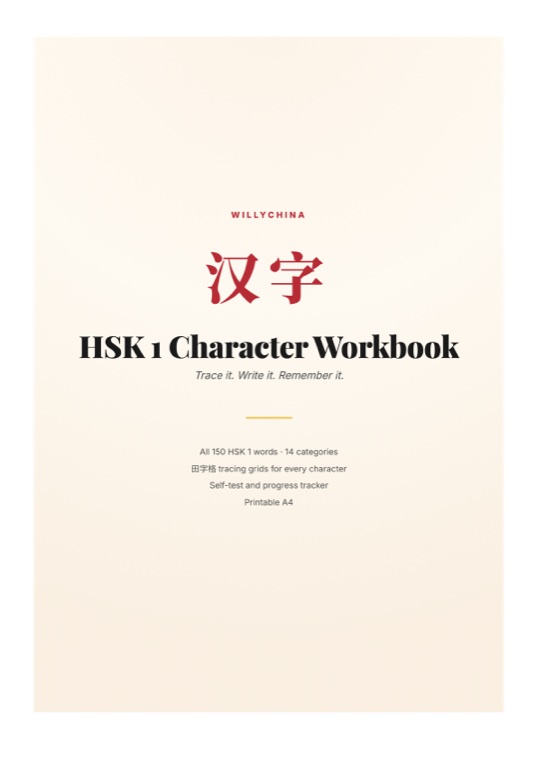
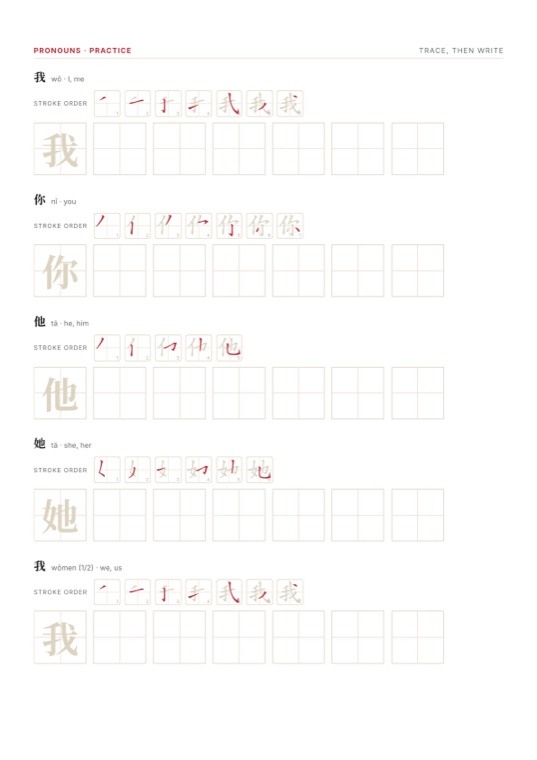
Once the syllables are in your ear, the next step is words. The HSK 1 Complete Pack covers all 150 HSK 1 words — 300 audio files at natural and slow speed, a 70-page workbook with 田字格 tracing grids, and Anki decks in both directions.
See what is inside — US$32 →One payment · instant download · yours to keep
Tap any syllable — hear native Mandarin
Tap the famous “ma” example for the four tones plus neutral, drill the most-confused initial pairs, then use the full chart below — every one of the 237 Mandarin syllables plays.
Drill mode — the most-confused initial pairs
The retroflex initials (zh, ch, sh) versus dental sibilants (z, c, s) are where most beginners stumble. Tap any chip to hear it.
| Final ↓ / Initial → | b | p | m | f | d | t | n | l | g | k | h | j | q | x | zh | ch | sh | r | z | c | s |
|---|---|---|---|---|---|---|---|---|---|---|---|---|---|---|---|---|---|---|---|---|---|
| a | a | ba | pa | ma | fa | da | ta | na | la | ga | ka | ha | zha | cha | sha | za | ca | sa | |||
| o | o | bo | po | mo | fo | ||||||||||||||||
| e | e | me | de | te | ne | le | ge | ke | he | zhe | che | she | re | ze | ce | se | |||||
| i | i | bi | pi | mi | di | ti | ni | li | ji | qi | xi | zhi | chi | shi | ri | zi | ci | si | |||
| u | u | bu | pu | mu | fu | du | tu | nu | lu | gu | ku | hu | zhu | chu | shu | ru | zu | cu | su | ||
| ü | ü | nü | lü | ju | qu | xu | |||||||||||||||
| ai | ai | bai | pai | mai | dai | tai | nai | lai | gai | kai | hai | zhai | chai | shai | zai | cai | sai | ||||
| ei | ei | bei | pei | mei | fei | dei | nei | lei | gei | kei | hei | zhei | shei | zei | |||||||
| ao | ao | bao | pao | mao | dao | tao | nao | lao | gao | kao | hao | zhao | chao | shao | rao | zao | cao | sao | |||
| ou | ou | pou | mou | fou | dou | tou | nou | lou | gou | kou | hou | zhou | chou | shou | rou | zou | cou | sou | |||
| an | an | ban | pan | man | fan | dan | tan | nan | lan | gan | kan | han | zhan | chan | shan | ran | zan | can | san | ||
| en | en | ben | pen | men | fen | den | nen | gen | ken | hen | zhen | chen | shen | ren | zen | cen | sen | ||||
| ang | ang | bang | pang | mang | fang | dang | tang | nang | lang | gang | kang | hang | zhang | chang | shang | rang | zang | cang | sang | ||
| eng | eng | beng | peng | meng | feng | deng | teng | neng | leng | geng | keng | heng | zheng | cheng | sheng | reng | zeng | ceng | seng | ||
| ong | ong | dong | tong | nong | long | gong | kong | hong | zhong | chong | rong | zong | cong | song |
Most-confused pair — drill these first Standard syllable — tap to hear it
What is pinyin?
Pinyin was developed in 1950s China and adopted internationally in 1982 as the global standard for romanising Mandarin. Every modern Mandarin textbook, dictionary and language app uses it as the entry point to pronunciation. If you’re learning Mandarin online, mastering pinyin first is the single highest-leverage move you can make: it lets you sound out any word, look up any character in a dictionary, and type Chinese on any device.
Most beginner pinyin charts you find online are incomplete, fuzzy scans, or designed for native speakers who already know how each syllable sounds. The chart in this PDF is built specifically for English speakers learning Mandarin online, with the most commonly confused pairs flagged in red and a clear tone-mark legend on the same page.
Pinyin initials and finals
Mandarin pinyin splits every syllable into two halves: the initial (the consonant sound at the start of the syllable) and the final (the vowel sound, with an optional ending consonant). There are 21 initials and 35 finals. Almost every Mandarin word is built by combining one initial with one final, plus a tone.
| Initial group | Examples | Closest English sound |
|---|---|---|
| Labials | b, p, m, f | Same as English |
| Alveolars | d, t, n, l | Same as English |
| Velars | g, k, h | Same as English (h is breathier) |
| Palatals | j, q, x | No English equivalent — tongue forward, soft |
| Retroflex | zh, ch, sh, r | Tongue curled back (no direct English equivalent) |
| Dental sibilants | z, c, s | Tongue flat against teeth |
The hardest groups for English speakers are the palatals (j, q, x) and the retroflex consonants (zh, ch, sh, r) — neither family has a direct English equivalent. The PDF chart highlights these pairs so you can drill them in isolation before mixing them with everyday vocabulary.
How to read the pinyin chart
The chart is organised with initials across the top and finals down the left side. Where a row and column intersect, you get a valid Mandarin syllable. Empty cells (marked with a dash) are not valid Mandarin syllables — for example, there’s no jia initial paired with the o final in Standard Mandarin.
Cells highlighted in soft red are the most commonly confused pairs — the retroflex (zh, ch, sh) versus dental sibilants (z, c, s) family. Drill these first: it’s where most beginners stumble and where Mandarin speakers will notice an accent immediately.
The 4 tones + neutral
Every Mandarin syllable carries a tone — the same syllable with a different tone is a different word. Master these five contours and your spoken Mandarin instantly sounds correct to native ears. The most famous example is the syllable “ma”:
mother
hemp
horse
scold
question
Tone marks always sit above the main vowel. For multi-vowel finals like iao or uei, the mark goes on the vowel closest to “a” (or to “o” or “e” if no “a” is present). The PDF chart has a dedicated tone-mark legend on the same page as the syllable grid so you can cross-reference without flipping back and forth.
Why tones matter more than you think
To English speakers, tones often feel optional — an accent you can drop without losing meaning. They aren’t. Mandarin’s small syllable inventory (~400 unique syllables versus 12,000+ in English) means a single syllable like ma can mean five completely different things depending only on tone. Drop the tone, and a sentence becomes ambiguous or nonsensical. Master the tones early and your spoken Mandarin will be understood — ignore them and you’ll be repeating yourself forever.
Common pinyin mistakes
After teaching hundreds of beginners online, here are the most frequent errors English speakers make — and how to fix them.
Beyond these consonant pairs, two more errors come up almost universally: dropping tones entirely (treating pinyin as if it were just English-style romanisation), and confusing the umlauted ü with regular u in syllables like nü (woman) versus nu (anger). The PDF has these flagged explicitly.

Want a native speaker to walk you through every syllable?
Pinyin is exactly what we drill in the first lessons of our 1-on-1 beginner Mandarin course. Will catches the pronunciation mistakes that flashcards never will.
Book a free 30-min intro →How to practise this chart
Owning the chart is the easy part. Building it into your daily Mandarin study is what makes the difference. Here’s the routine WillyChina recommends to every beginner:
- Print the PDF and put it somewhere visible — fridge, study wall, behind your monitor. Passive exposure adds up.
- Drill 5 syllables per day with native audio. Apps like Pleco, HelloChinese or ChinesePod have native pronunciation for every syllable. Don’t practise in silence — you’ll teach yourself the wrong sounds.
- Always practise with tones. Never read a syllable like “ma” without locking in a tone. Saying tonally-flat pinyin teaches your mouth bad habits.
- Record yourself. Compare your audio to native speakers. Most learners think they sound closer than they actually do — recording forces honesty.
- Drill the confused pairs first. zh/z, ch/c, sh/s, j/zh, x/sh, u/ü — isolating these costs you a day and saves months of being misunderstood.
- Get live feedback. A teacher can hear what you can’t. Even one lesson per week corrects entrenched mistakes faster than any app.
After two weeks of daily drilling with audio, you should be able to read pinyin from any Mandarin sentence — even if you don’t yet know what the characters mean. That’s the foundation everything else (HSK vocab, character recognition, conversation) builds on.
And if you’d like a native teacher to drill the harder sounds with you in real time — xi vs shi, zhi vs zi, the third-tone dip — that’s exactly what we cover in the first lessons of our 1-on-1 beginner Mandarin course.
FAQs
Want a teacher to walk you through this?
WillyChina pairs you with native and professional Mandarin teachers. Book a free 30-minute intro lesson — see if it’s a fit.
Book a Free Intro Lesson →Free PDF
Where should I send it?
Pop your email in and the PDF is yours — it lands in your inbox straight away.
I’ll send new resources now and then, and the odd note on learning Mandarin properly. Unsubscribe from any email.
Sent. Check your inbox — your download is starting now.